Conan O'Brien Needs a Friend
Johnny Knoxville (FULL EPISODE) | Conan O'Brien Needs A Friend

Episode Summary
AI-generated · Apr 2026AI-generated summary — may contain inaccuracies. Not a substitute for the full episode or professional advice.
Johnny Knoxville, known globally for the outrageous stunts and pranks of "Jackass," joins Conan O'Brien to share the incredibly unconventional arc of his career. Knoxville reveals that his path into participatory journalism and self-harm stunts was unexpectedly born out of fear: the need to quickly support his then-pregnant girlfriend and impending daughter. This led him to test self-defense equipment on himself, a bizarre but honest attempt to provide for his family, which accidentally laid the groundwork for his groundbreaking show.
The episode delves into the origins of "Jackass," detailing how magazine editor Jeff Tremaine suggested filming Knoxville's self-defense tests for "Big Brother" skateboarding magazine, with the initial cameraman bailing due to a gun being involved. Knoxville also shares a pivotal moment where he turned down a direct offer from Lorne Michaels for a weekly video segment on "Saturday Night Live." He chose instead to bet on himself and his friends, prioritizing creative control over the prestige of SNL, a decision that proved instrumental to "Jackass's" unique identity. Conan, reflecting on his own career, admits to a similar tendency to shed common sense for the sake of laughter and a camera.
Memorable anecdotes include Knoxville's arrest during the infamous "Hardware Store Bit," which not only almost got "Jackass" canceled but also led to MTV being banned from filming in West Hollywood for a decade due to a lack of permits. He reflects on his physical toll, stating he has no regrets about his extensive history of injuries, viewing them as simply "what it was." Knoxville, despite his daredevil persona, credits literary influences like Jack Kerouac's "On the Road" and Hunter S. Thompson's "Fear and Loathing in Las Vegas" for shaping his early life and career.
Knoxville also discusses his role as host of the new "Fear Factor," explaining how he found himself developing empathy for the contestants who genuinely faced phobias, a surprising shift for someone known for inflicting pain. He confirms that he can no longer perform stunts that risk concussions, having already sustained 16 throughout his career. The episode concludes with a humorous and surprisingly dark segment where Conan playfully interrogates his assistants, Sona Movsesian and David Hopping, about their loyalty and willingness to sacrifice their lives for him.
👤 Who Should Listen
- Fans of "Jackass" and Johnny Knoxville curious about the origins, philosophy, and behind-the-scenes stories of his career.
- Aspiring content creators and entertainers considering unconventional paths and the importance of creative control.
- Listeners interested in the psychological aspects of performance, humor, and why people engage in risky behavior for entertainment.
- Anyone interested in the unique dynamic between a celebrity and their personal assistants, explored through comedic and blunt questions.
- Individuals who appreciate a blend of candid storytelling, self-deprecating humor, and reflections on life's unexpected turns.
🔑 Key Takeaways
- 1.Johnny Knoxville's career in self-harm and participatory journalism originated from a need to support his pregnant girlfriend and impending daughter, leading him to test self-defense equipment on himself [11:19].
- 2.He turned down a significant offer from Lorne Michaels for a weekly video segment on "Saturday Night Live" to maintain creative control and work with his friends on what would become "Jackass" [14:21].
- 3.The genesis of "Jackass" occurred when "Big Brother" magazine editor Jeff Tremaine suggested filming Knoxville's self-defense articles, with the designated cameraman refusing due to the presence of a gun [12:20].
- 4.An incident involving Knoxville's fake prison escape at a West Hollywood hardware store led to his arrest and MTV being barred from filming in the area for over a decade because they lacked a permit [15:22].
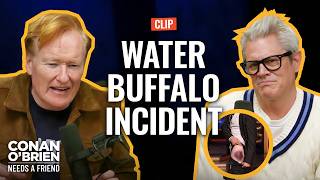
- 5.Conan O'Brien acknowledges his own tendency to abandon common sense and engage in unusual or dangerous acts, like being tossed by a water buffalo, when a camera is rolling and laughter is a potential outcome [17:23, 23:25].
- 6.Knoxville claims to have no regrets about the physical toll of his stunts, viewing his injuries and pain as an accepted part of his chosen path and admitting he's "not really in touch with my body" [25:28].
- 7.He revealed he can no longer perform stunts that would result in a concussion, having sustained 16 throughout his career, but remains unconcerned with other types of physical injury [42:53].
- 8.Knoxville credits Jack Kerouac's "On the Road" and Hunter S. Thompson's "Fear and Loathing in Las Vegas" as two books that profoundly influenced his early life and set his career path [27:30].
💡 Key Concepts Explained
Participatory Journalism
Johnny Knoxville's early career involved this method, where he would test self-defense equipment on himself and then write about the experience. Influenced by Hunter S. Thompson, Knoxville adopted this extreme form of reporting as his "best guess" for supporting his family, laying the foundation for his future stunts [11:19].
Creative Control vs. Mainstream Opportunity
This concept highlights Knoxville's choice to turn down a guaranteed spot on "Saturday Night Live" to develop "Jackass" with his friends. He opted for full creative autonomy, believing in his team and vision, rather than sacrificing control for a high-profile but constrained role [14:21].
Performance for Laughter
Both Conan O'Brien and Johnny Knoxville describe a psychological phenomenon where the presence of a camera and the potential for an audience's laughter overrides their common sense. This impulse leads them to perform dangerous, uncomfortable, or otherwise ill-advised acts that they would typically avoid [17:23, 23:25].
⚡ Actionable Takeaways
- →Prioritize creative control and collaboration with trusted friends over potentially higher-profile but less autonomous opportunities, as Knoxville did with SNL [14:21].
- →If in a police encounter, abide by commands immediately, as Knoxville learned during his hardware store arrest, which he noted saved him from further harm [16:22].
- →Cultivate empathy, even in competitive or challenging environments, as Knoxville found himself doing while hosting "Fear Factor" for contestants with genuine phobias [36:26].
- →For dangerous productions, seek out unconventional and uniquely skilled safety experts, like an alligator expert who is also a diver, for practical and experienced guidance [47:57].
- →If you are prone to concussions, make a conscious decision to avoid activities that risk head trauma, as Knoxville has done after sustaining 16 concussions [42:47].
⏱ Timeline Breakdown
💬 Notable Quotes
“"I only know how to make my friends laugh and if they're laughing, probably we're good." [19:24]”
“"You don't go to college, that's for sure." [10:17]”
“"I can do stunts. I just can't do anything where I get another concussion because I've — How many have you had? — 16." [42:47]”
“"It's funny until someone gets hurt and I always think it's actually when someone's feelings get hurt." [41:51]”
More from this guest
Johnny Knoxville
Listen to Full Episode
📬 Get weekly summaries like this one
No spam. Unsubscribe anytime. By subscribing you agree to our Privacy Policy.
Continue Exploring