My First Million
Naming billion dollar companies isn’t just vibes, here’s the science behind it.
Episode Summary
AI-generated · Apr 2026AI-generated summary — may contain inaccuracies. Not a substitute for the full episode or professional advice.
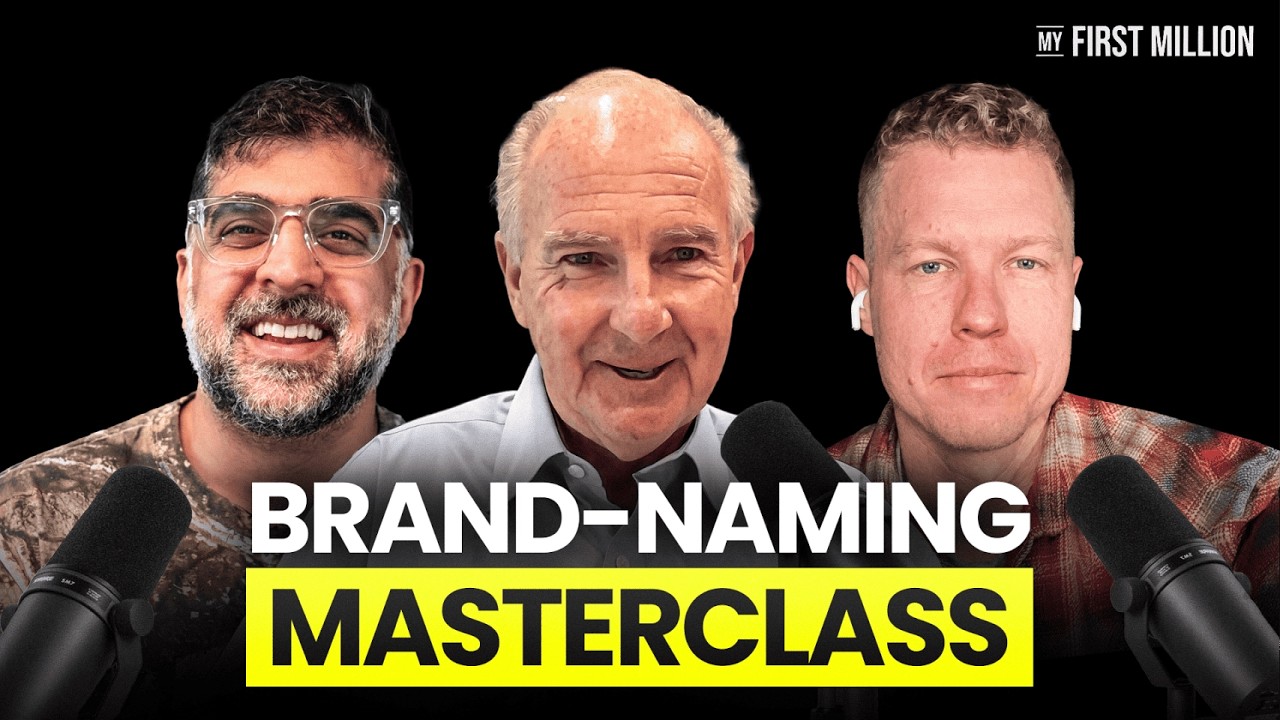
This episode features David Placek, founder of Lexicon Branding and the creative force behind iconic names like Impossible Burger, Blackberry, Swiffer, Febreze, and Sonos. Placek challenges the hosts' initial skepticism about the importance of company naming, asserting that a strategic name is the single most important and long-lasting element of a brand, compounding over time to create an asymmetric advantage. He argues that naming is not merely a creative whim but a science, crucial for building a billion-dollar company.
👤 Who Should Listen
- Startup founders and entrepreneurs embarking on a new venture or product launch.
- Marketing and branding professionals seeking a deeper understanding of naming strategy.
- Creative directors and team managers looking to optimize their team's creative output and process.
- Business leaders contemplating a name change or rebrand for an existing company or product.
- Anyone interested in the psychological and linguistic science behind memorable and impactful brand names.
🔑 Key Takeaways
- 1.Nothing you will do in your brand will be used more often or for longer than your name, and a 'right name' compounds over time to create a strategic, asymmetric advantage.
- 2.Effective names must achieve three critical objectives: they must get attention, be 'processing fluent' (understandable with a surprising element), and be truly surprising rather than merely comfortable or popular.
- 3.The difference between a strategic name like Swiffer (a $5 billion brand) and a comfortable name like Ready Mop (a $200 million brand) can be billions in revenue, with the name making 90-120% of the difference in the first 12 months.
- 4.The naming process is driven by 'creative curiosity,' involving a deep analysis of the market landscape, product, consumer needs, and an ultimate benefit (e.g., 'lighter' for fiber) rather than just descriptive features.
- 5.'Quantity leads to quality' in name generation; successful naming requires generating thousands of initial ideas, including what the agency internally calls 'trash,' to uncover truly original concepts, contrasting with clients who often stop at 50-100 names.
- 6.Managing creative teams effectively means encouraging 'courage' and separating idea generation from evaluation, using problem-solving propositions like 'How do we modify that word so it’s legally available?' instead of outright rejections.
- 7.Polarizing names are often good names because they possess inherent energy, a lesson learned from working with Intel CEO Andy Grove, who noted that a name being 'so polarizing' signifies internal energy.
- 8.Fear of losing equity or momentum when changing a bad name is unfounded, provided the launch is enthusiastic, story-driven, and clearly communicates the benefits of the new identity.
💡 Key Concepts Explained
Processing Fluency
This refers to a name's ease of cognitive processing. It means a name is not only pronounceable but also contains something understandable and 'surprisingly familiar' that the brain can grasp quickly, allowing it to grab and hold attention rather than being discarded due to mental friction.
Asymmetric Advantage
The core goal of a 'right name.' It refers to creating a strategic lead or disproportionate market advantage that a brand can leverage over competitors. Names like Impossible and Swiffer achieve this by being distinct and impactful, contributing significantly to their market success.
Creative Curiosity
Lexicon Branding's proprietary process for name generation. It combines rigorous, logical investigation (analyzing market landscape, product features, consumer needs, defining objectives) with speculative 'treasure hunting' for seemingly irrelevant connections (e.g., Greek roots, aerodynamics) to find unexpected and original naming angles.
Comfort Trap
The pitfall of choosing names that are safe, comfortable, and achieve high consensus internally. While seemingly easy, these names often lack distinctiveness, become 'invisible' in the marketplace, and fail to generate the energy or surprise needed for breakthrough success, according to Placek.
Sound Symbolism
The intuitive association of specific sounds and letters with certain qualities or perceptions. For example, letters like K, P, B, and X are often perceived as strong, fast, or innovative, and consciously incorporating these into names can subtly influence how a brand is perceived by consumers.
⚡ Actionable Takeaways
- →When naming a product, look beyond descriptive features to identify the 'ultimate benefit' for the consumer (e.g., 'lighter' for a fiber product) and build your naming strategy around that, rather than the commodity itself.
- →Encourage your creative teams to generate a vast quantity of ideas, recognizing that 'quantity leads to quality,' and avoid stopping too early in the ideation phase.
- →Structure creative teams to work in small, two-person units and provide them with diverse perspectives (e.g., product-focused, product+unrelated attribute, completely unrelated concept) to foster a wide range of name generation.
- →Separate the act of generating ideas from the act of judging them; create a 'dreaming room' mentality to allow creative flow without immediate evaluation.
- →When evaluating ideas from your team, avoid direct criticism; instead, offer problem-solving propositions such as 'I wish we could make that so it wasn't expensive' to encourage further creative thinking.
- →Present potential names to stakeholders as 'proofs of concept' by showing them in realistic contexts (e.g., a news headline, an advertisement) to help them visualize and believe in the name's potential.
- →To enhance personal creative output, dedicate 30 minutes to reading magazines or books completely unrelated to your project, suspending logic to look for 'synchronicity' and new perspectives that can inspire unique angles.
⏱ Timeline Breakdown
💬 Notable Quotes
“Nothing that you will do in your in your brand will be used more often or for longer than your name.”
“Quantity leads to quality.”
“Your current competitors who are all big companies would never have the courage to put Blackberry on a device.”
“This is a good name because it is so polarizing that means it has energy to it.”
More from this guest
David Placek
Listen to Full Episode
📬 Get weekly summaries like this one
No spam. Unsubscribe anytime. By subscribing you agree to our Privacy Policy.
Continue Exploring