The All-In Podcast
They're Opening the Stock Market to Everyone. Here's What That Actually Means
Episode Summary
AI-generated · Apr 2026AI-generated summary — may contain inaccuracies. Not a substitute for the full episode or professional advice.
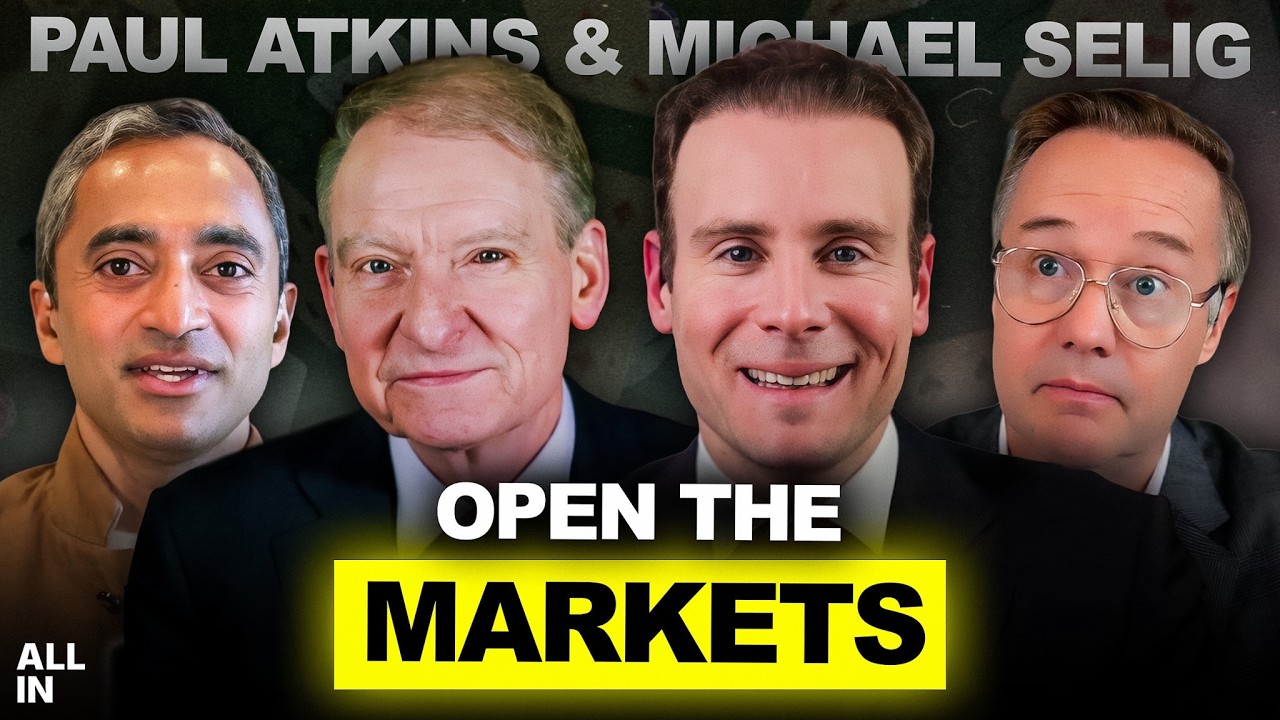
SEC Chair Paul Atkins and CFTC Chair Michael Celig join the All-In podcast to dissect the dramatic evolution of capital markets, from the mid-1980s when companies like Apple went public early for fundraising, to today's landscape where private capital dominates. They explain how this shift means insiders, private equity, and venture capital now capture the lion's share of returns, while public investors acquire more mature companies. The Chairs outline their joint efforts to modernize outdated regulations to reduce the cost and complexity of going public, foster innovation in digital assets, and harmonize oversight between their agencies, which historically operated like “two fortresses with no man’s land in between.”
The discussion highlights the three key inhibitions driving companies to stay private: the high cost of complying with SEC rules, the threat of vexatious class action lawsuits, and the “weaponization” of corporate governance through shareholder proposals. Both Chairs underscore the urgent need for “purpose-fit rules and regulations” for new technologies like crypto, prediction markets, and artificial intelligence, advocating for a “go build, don’t ask us for permission” approach within clear guardrails to prevent innovation from fleeing offshore. Celig, in particular, emphasizes the CFTC's role in policing fraud and manipulation in prediction markets, citing recent enforcement actions against insider trading in the Mr. Beast YouTube channel contract.
Atkins reveals plans to tackle the “ancient” accredited investor definition, arguing that the 1940 Investment Advisors Act includes “knowledge” as a criterion, suggesting a “driver’s test” equivalent for sophistication rather than solely relying on wealth. He also notes the historical shift in reporting cadence, from annual to quarterly, and the potential benefits of re-evaluating this for smaller companies. Both regulators stress the importance of clear, harmonized oversight for crypto assets, distinguishing between tokenized securities (SEC) and digital commodities/collectibles (CFTC) to prevent confusion and fraud.
Ultimately, the Chairs aim to balance market integrity and investor protection with the imperative to enable innovation, recognizing that American capital markets are the “envy of the world” due to robust rule of law and an equity investment culture. They express concern over the push of innovation offshore and the rise of sophisticated fraud, advocating for continuous adaptation of regulatory frameworks while also addressing the societal risks of increased gambling-like behaviors among young investors through education and robust suitability standards.
👤 Who Should Listen
- Investors interested in understanding the historical and current shifts between public and private capital markets.
- Entrepreneurs and innovators in digital assets, fintech, and AI seeking clarity on evolving regulatory frameworks from the SEC and CFTC.
- Policymakers and financial professionals interested in the challenges and strategies for modernizing financial regulations.
- Individuals concerned about investor protection, financial fraud, and the societal implications of increased participation in trading and wagering markets.
- Anyone exploring the future of capital formation, tokenization, and automated trading systems.
- Venture capitalists and private equity professionals looking to understand potential changes to fund formation and accredited investor rules.
🔑 Key Takeaways
- 1.Capital markets have shifted dramatically since the 1980s, with companies now staying private longer, leading to insiders, private equity, and venture capital capturing most returns before public offerings.
- 2.Three primary factors deter companies from going public: high regulatory compliance costs, threats of class action lawsuits, and the "weaponization" of corporate governance through shareholder proposals.
- 3.SEC Chair Paul Atkins plans a "spring cleaning" of the SEC's rulebook to focus on materiality and intends to re-evaluate the "ancient" accredited investor definition to potentially include knowledge-based criteria.
- 4.CFTC Chair Michael Celig advocates for "purpose-fit rules and regulations" for new technologies like crypto, AI, and prediction markets, emphasizing the need to move away from "regulation by enforcement."
- 5.The SEC and CFTC are working towards harmonizing their regulatory approaches through a Memorandum of Understanding to eliminate historical "turf battles" and reduce friction for cross-jurisdictional products.
- 6.Prediction markets are overseen by the CFTC, which requires exchanges to certify that contracts are not susceptible to insider trading or manipulation, with enforcement actions taken against violations.
- 7.A significant concern for both chairs is preventing innovation from fleeing offshore due to unclear or outdated regulations, balancing this with the critical need to protect investors from fraud and manipulation.
- 8.The historical cadence of corporate reporting has evolved from annual to quarterly, with the SEC now considering adjustments, particularly for smaller companies.
💡 Key Concepts Explained
Accredited Investor Definition
This refers to SEC rules, nearly a century old, that define who is qualified to invest in private companies and funds. Currently, it primarily relies on income or net worth thresholds, excluding 95% of Americans. The episode discusses proposals to update this definition to include criteria like 'knowledge' or a 'sophisticated investor test,' similar to a driver's license.
Self-Certification (CFTC)
A regulatory mechanism primarily used by the CFTC for repetitive financial products. Once a general framework for a product type is approved, market participants can self-certify that their specific products conform to the established rules. This approach is contrasted with the SEC's more labor-intensive approval process, making the CFTC's system more streamlined for innovation.
T0 (Immediate Delivery vs. Payment)
This refers to the concept of instantaneous settlement of financial transactions, where the delivery of an asset and the payment for it occur simultaneously. The episode highlights distributed ledger technology (blockchain) as a key enabler for achieving T0 in financial services, offering an exciting prospect for increased efficiency.
Regulation by Enforcement
A criticism leveled against past regulatory approaches, particularly in the crypto space. It describes a situation where regulators primarily address new market activities through enforcement actions rather than by providing clear, 'purpose-fit rules and regulations' upfront. This creates uncertainty and can stifle innovation, prompting calls for more proactive rulemaking.
⚡ Actionable Takeaways
- →Understand that investing in public companies today means buying into more mature businesses, with early-stage returns predominantly captured by private markets.
- →If you are an innovator in digital assets or new financial products, be aware that the SEC focuses on tokenized securities, while the CFTC oversees digital commodities, tools, and collectibles, and work towards regulatory clarity in your product design.
- →Recognize that the current "accredited investor" definition based on wealth is under review, and future changes might allow for participation based on demonstrated financial knowledge or sophistication.
- →For those interested in private market investments, be aware of the existing statutory limitations on fund participation and the ongoing governmental discussions about democratizing access with appropriate guardrails.
- →When evaluating investment platforms, especially those offering complex derivatives or crypto products, seek out those that provide educational resources and suitability checks, as mentioned in the context of Robinhood and broader market education.
- →Be vigilant against new forms of financial fraud, particularly those leveraging AI and manipulative communications, and understand that both the SEC and CFTC actively police these threats.
- →Parents should increase their awareness of their children's online activities related to trading and gambling, as highlighted by concerns about young men's participation in wagering markets.
⏱ Timeline Breakdown
💬 Notable Quotes
“Paul Atkins: "We need a spring cleaning. We need cleaning out the attic, the basement, and the garage and to really look at things unlike the agency has ever done before with a real focus on materiality." [05:05]”
“Michael Celig: "I really came into government to help write the ship to help make sure that we have purpose fit rules and regulations for new innovative technologies and financial products." [06:06]”
“Paul Atkins: "From my point of view, there's so many benefits to come from distributed ledger ledger technology for the financial services industry where we're right at the cusp of achieving T0 basically you know immediate delivery versus payment, receipt versus payment onchain by uh you know digital assets." [10:08]”
“Michael Celig: "I'm a believer in free markets and I really think that allowing more access to our capital markets is is really a powerful thing for everyday Americans." [43:40]”
Listen to Full Episode
📬 Get weekly summaries like this one
No spam. Unsubscribe anytime. By subscribing you agree to our Privacy Policy.
Continue Exploring