Lex Fridman Podcast
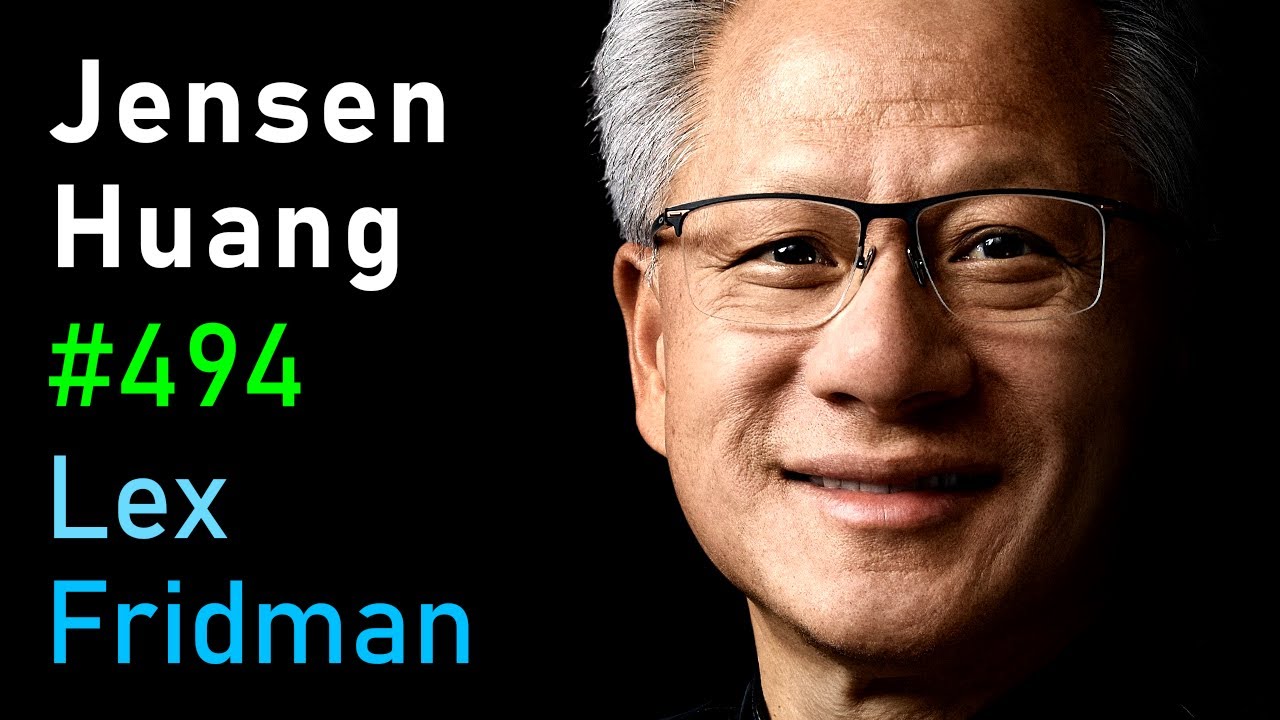
Jensen Huang: NVIDIA - The $4 Trillion Company & the AI Revolution | Lex Fridman Podcast
Episode Summary
AI-generated · Mar 2026AI-generated summary — may contain inaccuracies. Not a substitute for the full episode or professional advice.
This episode features a conversation with Jensen Huang, CEO of NVIDIA, focusing on the company's pivotal role in the AI revolution and his leadership philosophy. Huang explains NVIDIA's evolution from chip-scale design to "extreme co-design" at the rack and data center level, encompassing GPUs, CPUs, memory, networking, storage, power, and cooling. This holistic approach is necessary because complex problems now require distributed computing, aiming for speedups far beyond merely adding more computers.
Huang details the challenges and strategies behind this co-design, highlighting his unique management style where a large direct staff of 60+ experts from diverse disciplines collaborate on problems collectively rather than through one-on-one meetings. He traces NVIDIA's path from a specialized accelerator company to an accelerated computing company, mentioning key innovations like the programmable pixel shader, FP32 integration, Cg, and ultimately CUDA. A critical strategic decision was putting CUDA on GeForce GPUs, which, despite consuming significant profits and temporarily reducing NVIDIA's market cap from approximately $8 billion to $1.5 billion, was essential for building a developer "install base" – a foundation Huang argues is paramount for any computing architecture's success.
The discussion delves into Huang's leadership approach for making bold, future-defining bets. He emphasizes the importance of intense curiosity, a strong belief in a reasoned future, and a continuous process of shaping the belief systems of his board, management, employees, and even industry partners over time. This ensures widespread buy-in when major announcements are made. Finally, Huang discusses his continued belief in AI scaling laws (pre-training, post-training, test time, and agentic scaling) and addresses perceived blockers, arguing that synthetic data will overcome pre-training data scarcity and that inference ("thinking") is intensely compute-intensive, not simple, requiring significant resources for reasoning and planning.
👤 Who Should Listen
- Leaders & Team Managers
- Tech Professionals
- Early Adopters
- Software Engineers
🔑 Key Takeaways
- 1.NVIDIA has transitioned to "extreme co-design" across the entire computing stack, from individual components like GPUs and CPUs to full data center infrastructure, to solve complex distributed problems that no longer fit a single computer.
- 2.The necessity for extreme co-design arises from the goal to achieve speedups "a million times faster" than simply increasing the number of computers, requiring intricate sharding of algorithms, data, and models.
- 3.Jensen Huang leads with a unique organizational structure where a large staff of 60+ technical experts collaborates in group settings, allowing for a comprehensive, cross-disciplinary approach to problem-solving inherent to co-design.
- 4.A crucial strategic decision for NVIDIA was embedding CUDA into GeForce GPUs, despite incurring significant costs that severely impacted profitability and temporarily reduced the company's market cap, to establish a vital developer "install base" which ultimately powered the deep learning revolution.
- 5.Huang believes that the "install base defines an architecture" more than its elegance, illustrating this with the success of x86 versus more elegantly designed RISC architectures.
- 6.Jensen Huang's leadership strategy for bold bets involves intensely reasoning about a future outcome, then systematically shaping the belief systems of his team, board, and external partners over an extended period to ensure widespread buy-in for strategic shifts.
- 7.Huang maintains that AI scaling laws continue to hold, specifically highlighting that synthetic data will overcome limitations in human-generated data for pre-training, and that "inference" (thinking and reasoning) is a highly compute-intensive process, contrary to earlier assumptions that it would be simple.
💬 Notable Quotes
“Install base defines an architecture. Not... Everything else is secondary, okay?”
“I think thinking is hard. Thinking is way harder than reading.”
“There's a lot of suffering in between, but you've gotta believe what you believe.”
More from this guest
Jensen Huang
Listen to Full Episode
📬 Get weekly summaries like this one
No spam. Unsubscribe anytime. By subscribing you agree to our Privacy Policy.
Continue Exploring


