Lex Fridman Podcast
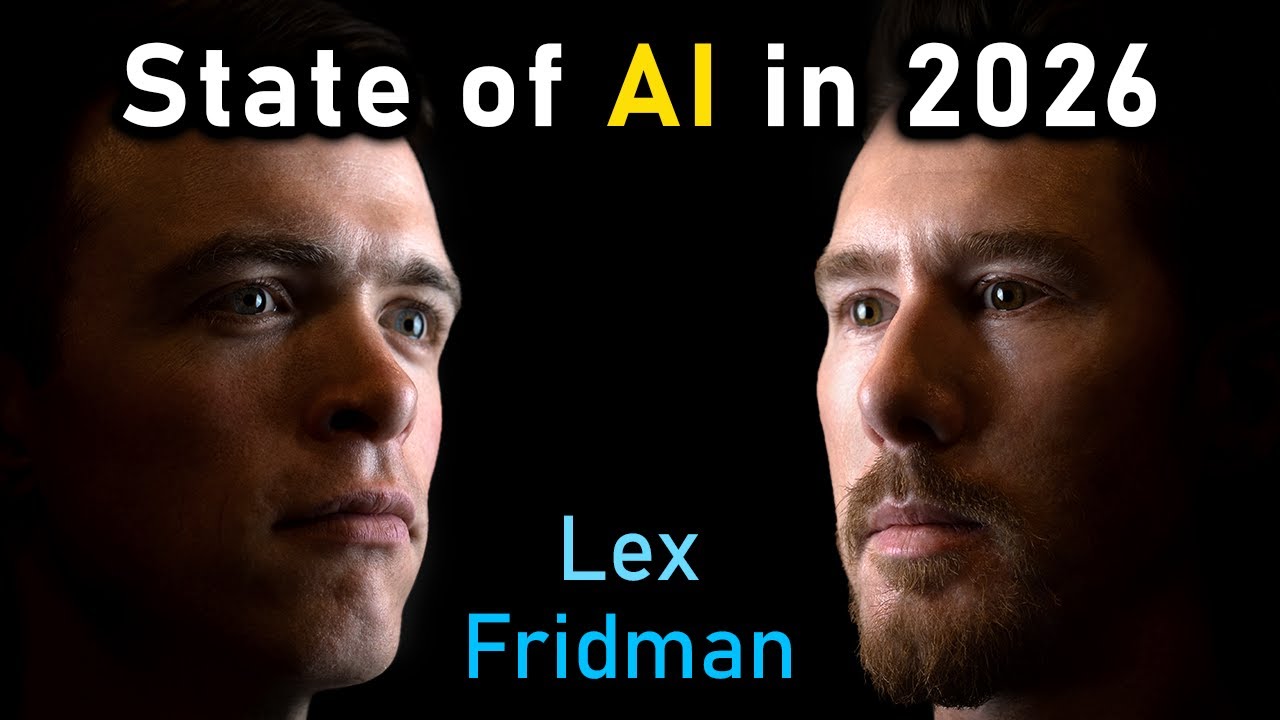
State of AI in 2026: LLMs, Coding, Scaling Laws, China, Agents, GPUs, AGI | Lex Fridman Podcast
Episode Summary
AI-generated · Mar 2026AI-generated summary — may contain inaccuracies. Not a substitute for the full episode or professional advice.
Lex Fridman hosts Sebastian Raschka and Nathan Lambert, respected machine learning researchers and engineers, to dissect the cutting-edge of artificial intelligence in 2026. The episode's central thesis explores the rapid advancements, shifting competitive landscape between US and Chinese AI, the nuanced application of scaling laws, and the complex ethical and practical implications for users and developers.
👤 Who Should Listen
- AI researchers and engineers interested in the latest LLM architectural advancements, scaling laws, and training paradigms.
- Software developers and programmers looking to understand how LLMs are transforming coding workflows and debugging.
- Leaders and strategists in the tech industry tracking the competitive dynamics between US and Chinese AI companies and open-weight models.
- Authors, content creators, and legal professionals navigating the evolving landscape of AI-generated content, copyright, and data licensing.
- Anyone concerned with the broader societal and ethical implications of AI, including its impact on human learning, mental well-being, and agency.
- Current users of LLMs (e.g., ChatGPT, Gemini, Claude) seeking a deeper understanding of the technology underpinning their favorite tools and future developments.
🔑 Key Takeaways
- 1.The 'DeepSeek moment' in January 2025, when the Chinese company DeepSeek released near-state-of-the-art open-weight models with allegedly less compute, ignited a furious global AI competition [02:05].
- 2.While US models like Claude Opus 4.5 and ChatGPT currently offer superior output quality for paying users, a growing number of Chinese companies like Z.ai, Minimax, and Kimi Moonshot are releasing increasingly strong open-weight models with highly permissive licenses [05:12, 20:33, 35:10].
- 3.Fundamental LLM architectures have remained largely unchanged since GPT-2, with advancements primarily driven by architectural tweaks (e.g., Mixture of Experts, Multi-head Latent Attention, Group Query Attention) and algorithmic progress in post-training techniques like Reinforcement Learning with Verifiable Rewards (RLVR) [37:14, 43:22, 49:30].
- 4.Scaling laws continue to hold across pre-training, reinforcement learning, and inference time, with significant recent gains from inference time scaling (allowing models to 'think' for extended periods) and RLVR, which enables tool use and better software engineering [49:30].
- 5.The quality and curated nature of training data are paramount; specialized techniques like Almost-OCR for scientific PDFs and using high-quality synthetic data (e.g., rephrased content, best ChatGPT answers) are crucial for model performance [64:56, 69:04].
- 6.Over-reliance on LLMs for core tasks like coding could diminish human fulfillment and hinder the deep learning that comes from struggling with problems, despite surveys indicating increased enjoyment for many developers [89:40, 95:45].
- 7.Ethical and legal challenges surrounding data licensing, copyright (highlighted by Anthropic's $1.5 billion lawsuit), and the management of LLMs in sensitive domains like mental health are critical, leading to a tension between utility and safety [76:19, 84:33].
- 8.Senior developers are more likely to ship over 50% AI-generated code than junior developers, suggesting that expertise lies not just in writing code, but in effectively leveraging and verifying LLM outputs [91:41].
💡 Key Concepts Explained
DeepSeek Moment
A significant event in January 2025 when the open-weight Chinese company DeepSeek released DeepSeek R1, surprising the AI community with near-state-of-the-art performance using allegedly much less compute. This moment accelerated global AI competition in both research and product development, particularly in open-weight models [02:05].
Mixture of Experts (MoE)
An LLM architectural tweak where a 'router' dynamically selects a small subset of specialized 'expert' feedforward networks to process input tokens. This allows models to be much larger and more knowledgeable without a proportional increase in compute cost during inference, making them more economical for long context [41:18, 37:14].
Reinforcement Learning with Verifiable Rewards (RLVR)
A post-training technique where LLMs learn by iteratively generating actions (e.g., using tools, executing code, performing web searches) and receiving reward signals based on verifiable outcomes. This method significantly unlocks complex capabilities like tool use and improved reasoning, dramatically changing how models acquire skills [49:30, 97:47].
Inference Time Scaling
A method to enhance LLM intelligence by allowing the model to perform extended internal 'thinking' or generation of intermediate thoughts over seconds, minutes, or even hours before producing its final output. This capability, exemplified by OpenAI's o1 thinking models, significantly improves problem-solving and enables more sophisticated use cases [49:30].
Pre-training, Mid-training, and Post-training
These are distinct stages in LLM development. **Pre-training** involves initial next-token prediction on massive, diverse datasets. **Mid-training** is a more specialized phase focusing on high-quality or specific data (e.g., long-context documents). **Post-training** involves refinement techniques like supervised fine-tuning, DPO, and RLHF/RLVR to align models with human preferences and unlock specific skills [63:56, 65:58, 67:44].
⚡ Actionable Takeaways
- →Explore diverse LLM models like Claude Opus 4.5 for coding, Gemini for quick factual queries, or Grok 4 Heavy for debugging to find the best fit for specific tasks [16:29, 17:31].
- →Utilize LLMs to automate mundane, time-consuming tasks (e.g., fixing broken links, website tweaks) to free up mental energy for more complex or enjoyable work [92:42].
- →Develop agency by actively building with AI, such as creating apps or tools, to gain practical intuition about its capabilities and limitations, rather than passively consuming AI outputs [88:38].
- →When learning new concepts, consider a 'two-pass' approach: first, dedicate focused offline time for deep understanding, then use an LLM for clarification or additional context in a second pass [25:48].
- →If you are an open-source project maintainer, anticipate and develop strategies for handling an influx of LLM-generated pull requests, which may require human verification and curation [78:23, 79:24].
- →For those in specialized industries (e.g., pharma, law, finance), plan for in-house LLM development using proprietary data, as this could unlock domain-specific capabilities beyond general-purpose models [75:19].
- →Cultivate a Goldilocks zone for learning and problem-solving, allowing for productive struggle to build expertise, but using LLMs to avoid excessive frustration and accelerate progress on non-core tasks [94:45].
⏱ Timeline Breakdown
💬 Notable Quotes
“"I don't think nowadays, in 2026, that there will be any company that has access to technology that no other company has access to... The differentiating factor will be budget and hardware constraints. I don't think the ideas will be proprietary, but rather the resources needed to implement them." - Sebastian Raschka [03:05]”
“"The simple thing is: the US models are currently better, and we use them. I tried these other open models, and I'm like, 'Fun, but not gonna... I don't go back to it.'" - Nathan Lambert [20:33]”
“"I wouldn't say pre-training scaling is dead, it's just that there are other more attractive ways to scale right now. But at some point, you will still want to make some progress on the pre-training." - Sebastian Raschka [61:53]”
“"It's kinda fascinating to watch... for me, I look at the difference between a summary and the original content. Even if it's a page-long summary of a page-long content, it's interesting to see how the LLM-based summary takes the edge off. What is the signal it removes from the thing?" - Lex Fridman [81:27]”
More from this guest
Sebastian Raschka and Nathan Lambert
Listen to Full Episode
📬 Get weekly summaries like this one
No spam. Unsubscribe anytime. By subscribing you agree to our Privacy Policy.
Continue Exploring


