Invest Like the Best
How AI Is Changing Warfare | Palantir CTO
Episode Summary
AI-generated · Mar 2026AI-generated summary — may contain inaccuracies. Not a substitute for the full episode or professional advice.
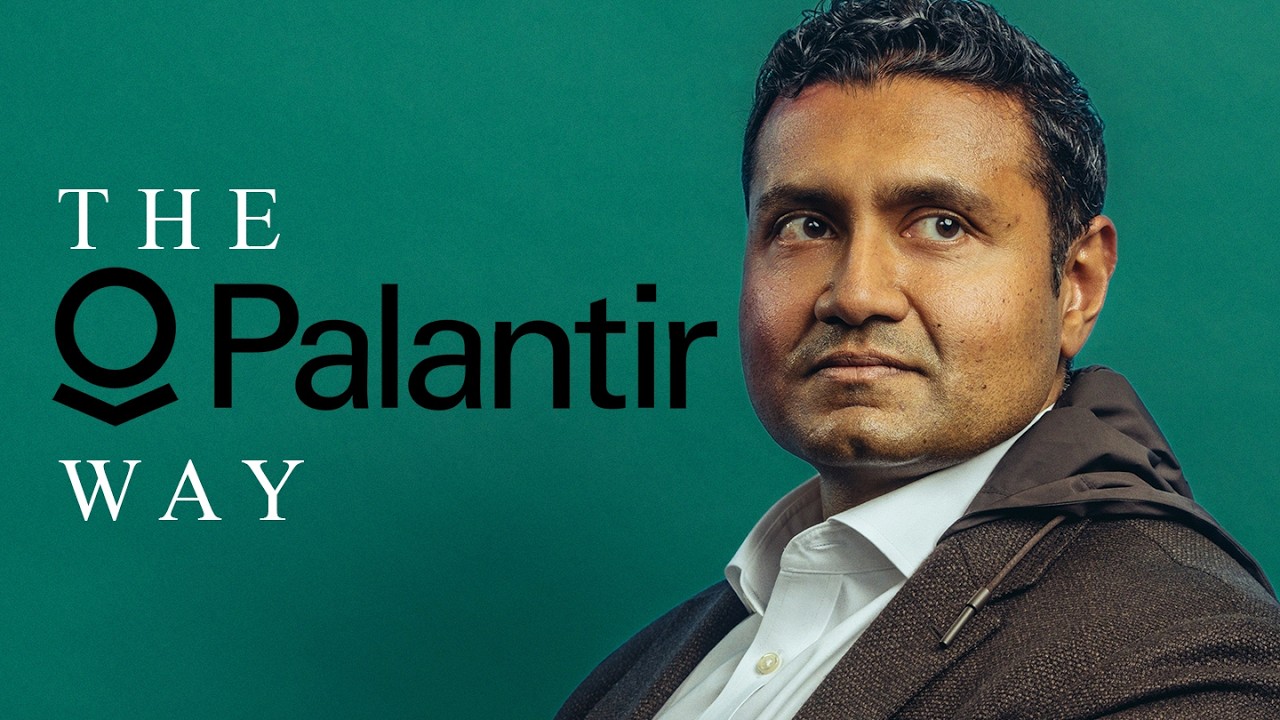
Sham Sankar, CTO of Palantir Technologies, offers a deeply personal and urgent worldview on the imperative to re-industrialize the United States, drawing parallels between Palantir's innovative culture and historical military 'heretics.' Sankar argues that all significant advancements, particularly in national security, originate from individuals who defy bureaucracy to build impactful solutions. This episode is a passionate call to action, emphasizing that the US has lost its industrial base and thus, its capacity for certain types of innovation, leading to a decline in strategic deterrence against adversaries like China. He posits that AI, combined with a renewed focus on domestic production and empowering entrepreneurial 'heretics,' can serve as 'David's slingshot' to restore American preeminence.
Sankar delves into the concept of 'heretics,' exemplified by figures like Hyman G. Rickover, who almost single-handedly built the US nuclear submarine force despite immense institutional resistance. He connects this ethos to Palantir’s unique 'artist colony' culture, where talent is unlocked through high-stakes 'gamma ray moments'—forcing individuals into situations where they are over their heads to accelerate learning. The conversation extensively explores Palantir's 'forward deployed engineering' model, which eschews traditional sales for embedding engineers directly with operators to build software through continuous feedback, focused on real-world impact rather than just fulfilling contracts. This approach, Sankar explains, is crucial for addressing complex, heterodox problems that defy conventional product categories.
A significant portion of the discussion is dedicated to the erosion of the US industrial base, contrasting post-WWII 'dual-purpose' companies (like Chrysler building missiles and minivans) with today's specialized defense contractors, which Sankar argues has stifled innovation and mass production capabilities. He critically examines China's long-term, deceptive strategy, highlighting that its economic prosperity is often predicated on America's failure. Sankar insists that innovation is a consequence of productivity, meaning the US cannot outsource manufacturing and expect to retain its innovative edge. To reverse this, he proposes radical policy changes, such as incentivizing domestic production (e.g., through patent manipulation for pharmaceuticals) and empowering a new generation of 'heretics' within both the private and public sectors.
Listeners will walk away with a profound understanding of the historical forces shaping America's industrial and military capabilities, a detailed look into Palantir's unconventional software development and talent management, and a stark, yet optimistic, vision for leveraging AI and human ingenuity to confront pressing national security and economic challenges. Sankar's blend of historical anecdote, personal philosophy, and strategic foresight provides a compelling framework for thinking about national competitiveness in the 21st century.
👤 Who Should Listen
- Technology leaders and product managers interested in Palantir's unique forward-deployed engineering and ontology approach.
- Founders and entrepreneurs seeking to cultivate a high-performance, 'heretic-driven' culture in their organizations.
- Individuals involved in national security, defense policy, or industrial strategy who want to understand the challenges of US-China competition.
- Policymakers and economists concerned with the re-industrialization of the United States and the impact of AI on manufacturing.
- Anyone interested in the intersection of technology, geopolitical power, and the historical drivers of national strength.
- Leaders struggling with bureaucratic inertia and seeking strategies for fostering radical innovation and accountability.
🔑 Key Takeaways
- 1.All significant military and national advancements are driven by 'heretics'—founders and innovators who defy conventional bureaucracy at personal cost, as seen with figures like Hyman G. Rickover who pioneered nuclear submarines [01:54].
- 2.Palantir fosters an 'artist colony' culture that unlocks talent by identifying individuals' 'superpowers' (effortless unique abilities) and 'kryptonite' (unfixable weaknesses), and empowering them to focus on the former while avoiding the latter [17:21].
- 3.Learning and growth are maximized in 'gamma ray moments'—high-stakes, deeply uncomfortable situations where individuals are pushed beyond their experience, rather than through linear career progressions [22:19].
- 4.Palantir’s 'forward deployed engineering' model places technical personnel directly with end-users in the field, ensuring software is built through continuous 'back propagation' for real-world impact, addressing problems traditional product development misses [29:27].
- 5.The US industrial base has fundamentally shifted from 'dual-purpose' companies (e.g., General Mills building torpedoes) to defense specialists, leading to a loss of mass production capability and intertwined civilian-military innovation [47:18].
- 6.The 'biggest lie of globalization' is the belief that the US can innovate while other countries produce; innovation is inherently a consequence of productivity, and outsourcing production also cedes innovation [51:57].
- 7.China's primary asymmetric advantage is long-term planning, whereas the US's strength lies in its ability to be unpredictable, rapidly pivot, and empower 'heretics' in moments of crisis, especially with AI [59:58].
- 8.AI can serve as 'David's slingshot' to re-industrialize the US by making American workers 50 times more productive, thus changing the efficient frontier of what can be manufactured domestically [53:45].
- 9.To address the decline in US deterrence and industrial capacity, policy must focus on incentivizing domestic production (e.g., extending patent length for pharmaceutical companies that manufacture their global supply in the US) and fostering a culture that celebrates 'heretics' in defense [61:30], [64:39].
💡 Key Concepts Explained
Heretics (in military/innovation lore)
Individuals, often founders, who, against overwhelming institutional resistance, design and implement solutions that drive significant success. They are characterized by a 'pathological obsession with winning' and a willingness to defy bureaucracy, often at great personal cost, only becoming recognized as heroes much later [01:13], [02:02].
Gamma Ray Moments
A metaphor for intense, high-stakes experiences where an individual is 'irradiated' with immense responsibility and challenge, pushing them far beyond their comfort zone. Palantir uses this approach to accelerate learning and foster talent, believing that rapid growth occurs when one is forced to swim in the 'deep end' [21:40], [23:19].
Forward Deployed Engineering (FDE)
Palantir's unique software development model where engineers are embedded directly with end-users (e.g., on a factory floor or in a foxhole) to build and refine software through continuous feedback and 'back propagation.' This ensures the software generates real-world impact and addresses specific operational problems, rather than just meeting abstract requirements or sales targets [29:00], [30:27].
Ontology (Palantir's)
Within Palantir's enterprise operating system, the ontology is an abstraction layer that models not only an organization's data but also its actions and relationships. It essentially makes the business programmable, serving as an 'API layer' to manage the entire 'decision chain' from suppliers to customers, going beyond traditional data models [36:34], [37:00].
Quantum Org Structure
An organizational design concept where the structure is fluid and can 'crystallize' into the most effective form to solve the problem at hand today, and then 'reform' as the problem evolves. This avoids the ossification of fixed structures and allows for continuous adaptation, preventing the 'entropy' of an organization from working against it [26:42], [27:24].
⚡ Actionable Takeaways
- →Identify your own 'superpower'—the unique ability that comes effortlessly to you—and strive to focus your professional contributions primarily on exercising it, delegating or avoiding tasks that fall into your 'kryptonite' [18:03].
- →Seek out 'gamma ray moments' by deliberately taking on projects or roles for which you feel unqualified, understanding that maximum learning coincides with maximum discomfort and high stakes [23:19].
- →If you lead a team, consider institutionalizing 'weeks of revolt' or similar mechanisms to encourage employees to challenge existing methods and build innovative, heterodox solutions that prove current processes wrong [73:00].
- →As a leader, foster a transparent culture where direct feedback and challenging authority are encouraged, even explicitly telling employees to 'tell me to f*** off to my face' to cultivate truth-seeking [72:18].
- →Prioritize continuous, dynamic re-prioritization of your project backlog and resources in response to new data and changing realities, accepting that this process will cause internal 'whiplash' but is essential for winning [68:56].
- →When facing national security challenges, remember that 'the person is the program'; prioritize putting world-class 'heretics' in charge of critical initiatives over rigid bureaucratic processes [78:20].
- →To address industrial decline, advocate for specific policy interventions (like patent length manipulation in pharma) that create clear business cases for companies to re-shore production, rather than relying on generic 'free trade' or 'French shoring' concepts [64:39], [53:45].
⏱ Timeline Breakdown
💬 Notable Quotes
“Well, I think they're really founders, you know, they're founder figures uh and they get obsessed with delivering something that it makes no sense because they're fighting particularly in the military context. You're like fighting the bureaucracy. You're going to end your career. You pay extreme prices for it. So there's almost like a pathological obsession with winning which I really relate to both personally but also that's what I see in great founders. I think in the present moment it's really important to like encourage the that the hidden heretics who are in there in the military today to recognize like your heresy matters. And frankly if you look back at history the only [things] that ever worked the things that helped us win all the wars were the things that the heretics actually did. Nothing that went through the machine delivered anything.”
“Superpowers are effortless and therefore they're in some sense it's almost like not even rewarding to exercise your superpower. My analogy for this is it Superman could fly. He could see through walls. But that wasn't some sort of arduous thing for him to do. It's just something he could do. And that's usually something you learn comparatively. Like you're like, 'Oh, this thing that's like lizard brain effortless almost thoughtless for me other people who are really smart can't seem to do or I do just way better.' And embracing that is the first step. And then rec and helping them understand like, hey, all of your contributions to the world are going to come from your superpower. like everything else is basically a waste of time. So how do you figure out how to get into that configuration? So there's there's some releasing of ego around that as well is understanding that okay like this is what I need to focus on. The other part of this is kryptonite. You know there are some set of weaknesses you have that aren't just like hey I'm not like I'm kind of average or I'm maybe a standard de below average. It's like you're like six deves below average here. It's not like something you can work on. The only strategy for Superman around kryptonite was to avoid it.”
“The biggest lie that we bought from globalization is this concept of we will do the innovation and they will do the production. And what you have to recognize that innovation is itself a consequence of productivity.”
“So, John Boyd's advice to to other officers, uh, other uniform service members always like, look, you can either be somebody or you can do something, but you can't really have both. And if you're going to be somebody, you got to play this game and it's all kind of theater, but you're going to get promoted and you're going to get the accolytes and you're going to get the rewards of doing that and you're going to feel good about yourself. where you actually do something and it's going to feel really shitty and no one's going to appreciate it, but you're going to have the intrinsic reward of knowing that you did something.”
More from this guest
Sham Sankar
Listen to Full Episode
📬 Get weekly summaries like this one
No spam. Unsubscribe anytime. By subscribing you agree to our Privacy Policy.
Continue Exploring