Valuetainment
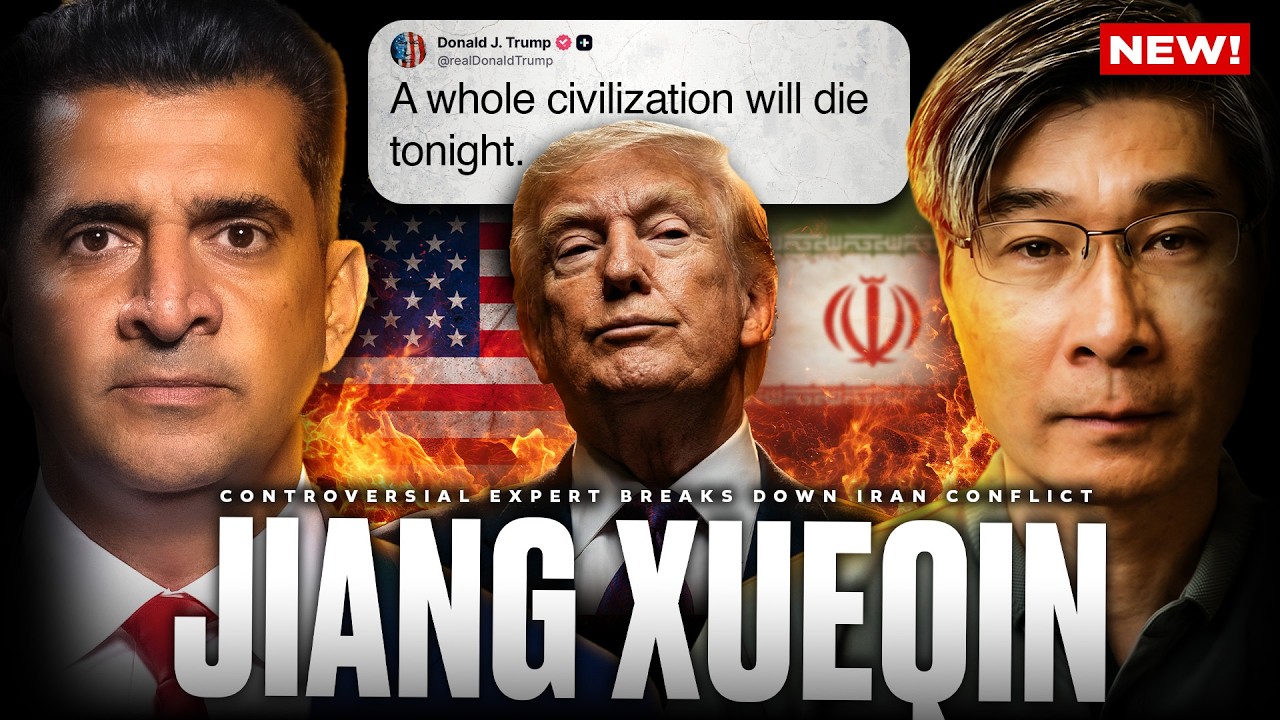
Jiang Xueqin Finally Breaks His Silence With PBD | PBD
Episode Summary
AI-generated · Apr 2026AI-generated summary — may contain inaccuracies. Not a substitute for the full episode or professional advice.
Jiang Xueqin, an educator based in Beijing known for his unique geopolitical analyses and sometimes controversial predictions, joins Patrick Bet-David to break his silence on recent events. Xueqin notably predicted Trump's re-election, a subsequent war with Iran, and an American loss in the conflict. This episode delves into the historical patterns guiding these predictions, the potential ramifications of the current US-Iran standoff, and Xueqin's unvarnished perspective on China's internal dynamics and geopolitical role.
Xueqin explains his prediction of American defeat in an Iran war through a historical pattern of imperial decline, where "hubris" leads empires like the Persians and Athenians to engage in "risky wars that they believe they can win easily." He cites the US experience in Vietnam as a modern example, arguing that the US would lack the manufacturing and logistics to sustain a prolonged war in Iran's mountainous terrain. He points to Trump's past actions, such as moving the American embassy to Jerusalem and assassinating General Qassem Soleimani, as clear indicators of a hawkish stance towards Iran that would escalate in a second term. When dissecting Trump's cryptic social media posts, Xueqin suggests they are a form of "huff and puff" or "flexing," rooted in Trump's reality TV background and advisors whom Xueqin describes as "psychopaths."
Providing a grim outlook on the conflict, Xueqin estimates a mere 1% chance for a best-case scenario peace agreement, compared to a 10% likelihood of a worst-case total war involving the bombing of Iran's power plants and the destruction of the GCC economy. He suggests a multi-vector ground invasion targeting Iran's oil exports and control of the Strait of Hormuz is about 40% likely. His definition of an American "loss" would involve a forced retreat from the Middle East, leading to Iran's control over GCC countries, the collapse of the petrodollar system, and potential civil war in America. He proposes a four-country conference—US, Russia, China, and Iran—excluding European, GCC, and Israeli involvement, to negotiate a new dollar-based trade relationship.
Shifting to China, Xueqin offers insights from his 25 years in the country. He addresses concerns about China's population, noting a rapidly aging demographic and declining fertility rates, though he still believes the population exceeds a billion. He attributes the "tang ping" (lying flat) movement among Chinese youth to pervasive corruption, inequality, and a "rigged game" that stifles individual advancement, rather than a lack of resources. He also discusses the crackdown on prominent figures like Jack Ma for questioning authority and Jimmy Lai for advocating democracy in Hong Kong, emphasizing China's one-party state where becoming a bureaucrat is the ultimate aspiration. He believes there is "almost no interest in democracy in China" due to a system that prioritizes bureaucracy and suppresses individual liberties. He also reveals his belief that COVID was an "American bioweapon funded by Tony Fauci" and subcontracted to the Wuhan lab.
Ultimately, this episode offers a rare and candid perspective from a unique observer, presenting a stark and often alarming alternative narrative to mainstream geopolitical analysis. Listeners are invited to confront predictions that challenge conventional wisdom regarding the future of US foreign policy, the stability of the global economic order, and the internal workings of the world’s rising powers.
👤 Who Should Listen
- Anyone interested in non-mainstream geopolitical predictions and analyses.
- Listeners curious about the potential outcomes and complexities of a US-Iran conflict.
- Individuals seeking an insider's perspective on China's society, economy, and political landscape.
- Those interested in the historical patterns of imperial rise and fall, and their relevance to current global powers.
- People who want to understand the 'tang ping' movement and its implications for Chinese youth and society.
- Critics of conventional media narratives looking for alternative viewpoints on international relations and significant global events like COVID-19.
🔑 Key Takeaways
- 1.Jiang Xueqin's core prediction involved Donald Trump winning the 2024 election, subsequently initiating a war with Iran, and the United States ultimately losing this conflict.
- 2.Empires historically decline due to hubris, leading them to engage in risky, ill-advised wars that drain resources, a pattern Xueqin applies to a potential US-Iran conflict.
- 3.Trump's past actions, such as moving the US embassy to Jerusalem and assassinating General Qassem Soleimani, suggest a consistent hawkish stance that would likely lead to war with Iran in a second term.
- 4.The worst-case scenario for a US-Iran war, a 10% likelihood according to Xueqin, involves the bombing of Iran's power plants and subsequent Iranian retaliation against the entire GCC economy, potentially cutting off 20% of the world's energy and 30% of its fertilizer.
- 5.A major loss for the U.S. in the Middle East would entail a forced retreat, enabling Iran to control GCC countries, dismantling the petrodollar system, collapsing the American economy, and potentially leading to civil war in the US.
- 6.Xueqin proposes a non-traditional peace conference involving only the United States, Russia, China, and Iran to collectively agree on a new trade relationship based on the US dollar, arguing that these four nations share an interest in maintaining the dollar as the global reserve currency.
- 7.China's population, while still over a billion, faces significant challenges from a rapidly aging demographic and declining fertility rates, compounded by local governments inflating population statistics for federal subsidies.
- 8.The "tang ping" (lying flat) movement in China stems from widespread economic apathy among young people due to a "rigged game" of corruption, inequality, and debt, offering little chance for individual advancement outside of becoming a bureaucrat.
- 9.From Jiang Xueqin's perspective, the Chinese government propagates a narrative that COVID-19 originated as an "American bioweapon" designed to harm Chinese society, a belief shared by many elite Chinese he has spoken with.
- 10.Xueqin maintains his independence from the Chinese government by not engaging with Chinese social media or state-affiliated reporters, acknowledging he operates in a "gray zone" as a non-citizen making content for Western audiences.
💡 Key Concepts Explained
Hubris and Imperial Decline
Jiang Xueqin explains that empires tend to decline due to hubris, believing they are invincible and engaging in risky, often ill-advised wars. This pattern, observed from ancient Persia and Athens to modern conflicts like Vietnam, leads to the expansion of valuable resources on unwinnable quagmires and ultimately weakens the empire.
Tang Ping (Lying Flat) Movement
This refers to a counter-culture movement among Chinese youth who opt out of the relentless 996 work culture (9 AM to 9 PM, 6 days a week). Xueqin attributes this apathy to massive corruption, inequality, and debt, creating a "rigged game" where young people feel they have no chance to get ahead, leading them to embrace a minimalist, indifferent lifestyle.
AI Surveillance State
China has developed an advanced AI surveillance state utilizing digital IDs, digital currency, and mobile phone tracking. This system allows the government to monitor citizens' online activities, purchases, and movements, enabling micro-analysis of political leanings and targeted influence, effectively eliminating spaces for dissent.
⚡ Actionable Takeaways
- →Reflect on historical patterns of imperial overreach and hubris, as described by Jiang Xueqin, to critically evaluate current geopolitical strategies and potential outcomes.
- →Consider Jiang Xueqin's proposed four-country peace conference (US, Russia, China, Iran) as a non-mainstream framework for de-escalation in the Middle East, contrasting it with typical diplomatic approaches.
- →Examine the potential long-term implications of demographic shifts, particularly aging populations and declining fertility rates in countries like China, on global economic stability and societal structure.
- →Investigate the concept of the "tang ping" movement in China and its root causes, such as corruption and economic inequality, to better understand youth apathy in highly competitive societies.
- →Question official narratives surrounding global events, such as the origins of COVID-19, by considering diverse perspectives like Jiang Xueqin's belief in it being an American bioweapon.
- →Evaluate the extent of government surveillance and censorship in modern states, using China's described AI surveillance state as a case study, and reflect on its implications for individual freedom and open debate.
⏱ Timeline Breakdown
💬 Notable Quotes
“"Empires in decline, they tend to engage in risky wars that they believe they can win easily, but which forces them to expand valuable resources on a quagmire."”
“"Trump has surrounded himself with advisors who are psychopaths and they're not actually relaying to him good strategic advice."”
“"The worst case scenario is that Trump follows through and bombs all of Iran's power plants… and the Iranians are obligated now to destroy the entire economy of the GCC."”
“"America is going to have a hard time holding on to its empire… If you're an average American, you're paying way too much for this empire. So, why not just retreat back into the Western Hemisphere?"”
“"There is almost no interest in democracy in China because for democracy to exist in China... you would need to have people who respected human rights, individual liberty, who had empathy, who believed in rule of law."”
“"Chinese people know where the political red lines are… and so there's really no questioning of the government."”
“"I believe that this was American bioweapon funded by Tony Fouchi… and I don't know if it was accidental or deliberate but it got released into Wuhan."”
More from this guest
Jiang Xueqin
📚 Books Mentioned
Listen to Full Episode
📬 Get weekly summaries like this one
No spam. Unsubscribe anytime. By subscribing you agree to our Privacy Policy.
Continue Exploring


