Valuetainment
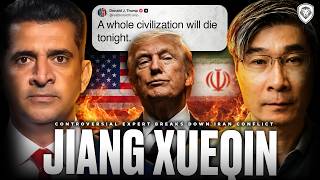
Jiang Xueqin Predicts U.S. vs Iran Will END BADLY

Episode Summary
AI-generated · Apr 2026AI-generated summary — may contain inaccuracies. Not a substitute for the full episode or professional advice.
In this episode of Valuetainment, guest Jiang Xueqin, a history teacher, presents a stark prediction: the United States is poised to go to war with Iran and will ultimately lose. His analysis is not based on current events alone, but on profound historical patterns he observes while teaching world history, specifically focusing on the decline of empires over millennia.
Xueqin identifies "hubris" as the major pattern leading to imperial decline. He explains that empires, in their perceived invincibility, engage in "activities that are not very strategic" and launch "risky wars that they believe they can win easily." These ill-advised campaigns often evolve into "quagmires" that exhaust an empire's resources, accelerating its downfall. He cites historical examples such as the Persian invasion of the Greek mainland around 490 BCE, which resulted in their destruction, and the Athenian empire's "silly invasion of Sicily" in 415 BCE during the Peloponnesian War, a key factor in their loss.
Applying this historical framework, Jiang Xueqin firmly believes that "if the United States would go to war with Iran, then it would lose this war." He argues that the U.S. would face significant practical limitations in such a conflict.
Specifically, Xueqin points to the United States' lack of adequate "manufacturing capacity" and a robust "logistics network" necessary to "sustain a war in the mountainous terrain of Iran." He references the Vietnam War as a recent example of the U.S. becoming entangled in a quagmire due to similar challenges. Listeners will walk away with a deep, historically-rooted perspective on the potential pitfalls of modern military intervention and the dangers of imperial overreach.
👤 Who Should Listen
- Anyone interested in geopolitical predictions concerning potential U.S.-Iran conflict.
- Students and enthusiasts of world history, particularly those studying empire rise and fall.
- Listeners curious about how historical patterns can inform contemporary foreign policy analysis.
- Individuals interested in military strategy, logistics, and the challenges of modern warfare in difficult terrain.
- Analysts and policymakers evaluating the long-term implications and risks of military interventions.
🔑 Key Takeaways
- 1.Jiang Xueqin predicts that the United States will go to war with Iran and subsequently lose the conflict.
- 2.His prediction is rooted in observed historical patterns of empire decline, particularly the role of 'hubris'.
- 3.Empires often decline after believing themselves invincible and engaging in 'risky wars' that they initially expect to win easily.
- 4.These risky wars frequently turn into 'quagmires' that drain an empire's resources, as exemplified by the Persian invasion of Greece (490 BCE) and the Athenian invasion of Sicily (415 BCE).
- 5.A key reason for the U.S. losing a war with Iran would be an insufficient 'manufacturing capacity' and 'logistics network' to sustain conflict in Iran's 'mountainous terrain'.
- 6.The Vietnam War is cited as a recent historical precedent for the U.S. becoming mired in a resource-intensive quagmire.
- 7.The tendency of declining empires to expand all their resources on unwinable wars is a consistent pattern throughout human history.
💡 Key Concepts Explained
Empire Decline through Hubris
This framework suggests that a critical factor in the decline of major empires is an overconfident belief in their own invincibility, or 'hubris'. This leads them to engage in ill-advised, risky wars that they expect to win easily but which instead become 'quagmires,' draining vast resources and accelerating their eventual collapse, as demonstrated by historical examples like the Persian and Athenian empires.
⚡ Actionable Takeaways
- →Critically evaluate claims of military invincibility by drawing parallels to historical empires that succumbed to 'hubris'.
- →Examine historical case studies, such as the Persian invasion of Greece or the Athenian invasion of Sicily, to understand how ill-advised military actions can lead to imperial decline.
- →Analyze current geopolitical tensions, especially concerning potential military engagements, through the lens of historical patterns of 'risky wars' and quagmires.
- →Consider the practical constraints of 'manufacturing capacity' and 'logistics network' when assessing the feasibility and potential outcomes of modern military conflicts.
- →Study the Vietnam War as a specific example of how a technologically superior military can struggle in challenging terrains against a determined adversary, impacting long-term resource allocation and national morale.
- →Apply a long-term historical perspective to current events to identify recurring patterns that may predict future outcomes, particularly in international relations and conflict.
⏱ Timeline Breakdown
💬 Notable Quotes
“"empires tend to decline...for a particular reason, which is hubris."”
“"empires in decline, they tend to engage in risky wars that they believe they can win easily but which forces them to expand all their resources on a quagmire."”
“"if the United States would go to war with Iran, then it would lose this war because the United States would not have the manufacturing capacity, logistics network in order to sustain a war in the mountainous terrain of Iran."”
More from this guest
Jiang Xueqin
Listen to Full Episode
📬 Get weekly summaries like this one
No spam. Unsubscribe anytime. By subscribing you agree to our Privacy Policy.
Continue Exploring