Topic
Best Authoritarianism Podcast Episodes
Authoritarianism is covered across 8 podcast episodes in our library and 2 expert guests — including Valuetainment. Conversations explore core themes like hubris and imperial decline, tang ping (lying flat) movement, ai surveillance state, drawing on firsthand experience and research from leading practitioners.
Below you'll find key insights, core concepts, and actionable advice aggregated from the top episodes — followed by a ranked list of the best authoritarianism discussions to explore next.
Key Insights on Authoritarianism
- 1.Jiang Xueqin's core prediction involved Donald Trump winning the 2024 election, subsequently initiating a war with Iran, and the United States ultimately losing this conflict.
- 2.Empires historically decline due to hubris, leading them to engage in risky, ill-advised wars that drain resources, a pattern Xueqin applies to a potential US-Iran conflict.
- 3.Trump's past actions, such as moving the US embassy to Jerusalem and assassinating General Qassem Soleimani, suggest a consistent hawkish stance that would likely lead to war with Iran in a second term.
- 4.The worst-case scenario for a US-Iran war, a 10% likelihood according to Xueqin, involves the bombing of Iran's power plants and subsequent Iranian retaliation against the entire GCC economy, potentially cutting off 20% of the world's energy and 30% of its fertilizer.
- 5.A major loss for the U.S. in the Middle East would entail a forced retreat, enabling Iran to control GCC countries, dismantling the petrodollar system, collapsing the American economy, and potentially leading to civil war in the US.
- 6.Xueqin proposes a non-traditional peace conference involving only the United States, Russia, China, and Iran to collectively agree on a new trade relationship based on the US dollar, arguing that these four nations share an interest in maintaining the dollar as the global reserve currency.
Key Concepts in Authoritarianism
Hubris and imperial decline
Jiang Xueqin explains that empires tend to decline due to hubris, believing they are invincible and engaging in risky, often ill-advised wars. This pattern, observed from ancient Persia and Athens to modern conflicts like Vietnam, leads to the expansion of valuable resources on unwinnable quagmires and ultimately weakens the empire.
Tang ping (lying flat) movement
This refers to a counter-culture movement among Chinese youth who opt out of the relentless 996 work culture (9 AM to 9 PM, 6 days a week). Xueqin attributes this apathy to massive corruption, inequality, and debt, creating a "rigged game" where young people feel they have no chance to get ahead, leading them to embrace a minimalist, indifferent lifestyle.
Ai surveillance state
China has developed an advanced AI surveillance state utilizing digital IDs, digital currency, and mobile phone tracking. This system allows the government to monitor citizens' online activities, purchases, and movements, enabling micro-analysis of political leanings and targeted influence, effectively eliminating spaces for dissent.
Real courage vs. zero courage in protest
This concept differentiates between the bravery required to protest in an authoritarian state, where one's life, family, and future are at catastrophic risk (e.g., Iran), and the perceived lack of courage for protesting in a democratic society, where personal consequences are minimal and safety is largely guaranteed (e.g., Western 'bluehead freaks'). The episode presents this distinction as crucial for understanding genuine oppression and activism.
Actionable Takeaways
- ✓Reflect on historical patterns of imperial overreach and hubris, as described by Jiang Xueqin, to critically evaluate current geopolitical strategies and potential outcomes.
- ✓Consider Jiang Xueqin's proposed four-country peace conference (US, Russia, China, Iran) as a non-mainstream framework for de-escalation in the Middle East, contrasting it with typical diplomatic approaches.
- ✓Examine the potential long-term implications of demographic shifts, particularly aging populations and declining fertility rates in countries like China, on global economic stability and societal structure.
- ✓Investigate the concept of the "tang ping" movement in China and its root causes, such as corruption and economic inequality, to better understand youth apathy in highly competitive societies.
- ✓Question official narratives surrounding global events, such as the origins of COVID-19, by considering diverse perspectives like Jiang Xueqin's belief in it being an American bioweapon.
Top Episodes — Ranked by Insight (8)
Valuetainment
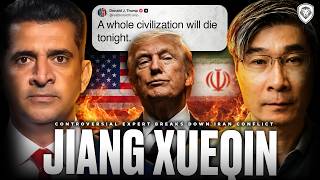
Jiang Xueqin Finally Breaks His Silence With PBD | PBD #772
Jiang Xueqin's core prediction involved Donald Trump winning the 2024 election, subsequently initiating a war with Iran, and the United States ultimately losing this conflict.

Valuetainment
Rita Panahi: This Is What REAL Oppression Looks Like
Protesting in countries like Iran demands immense courage, as individuals risk their lives, livelihoods, and families, facing "catastrophic" consequences if arrested.
Valuetainment
Iran Official Orders Shooting of Critics, Even Kids
An Iranian official issued a directive to "make an example" of anyone speaking out against the Islamic Revolutionary Guard to ensure perpetual silence.

Valuetainment
IRGC SURVIVES… Iranian Protesters Have NO Protection!
Iranian protesters face severe consequences if the IRGC survives, as they are unarmed, unprotected, and lack external support.

Valuetainment
Iran’s Regime Threatens Kids Who Show ANY Opposition
The Iranian regime directly warns parents that it will not be held responsible if their children show any form of opposition.

Valuetainment
Iranian State TV Calls for Punishment After Women’s Team Protest
The Iranian women's national soccer team protested by refusing to sing their national anthem during a competition in Australia.

Valuetainment
The TRUTH About Living Under The IRGC
Patrick Bet-David, born and raised in Iran, vividly remembers the fear and uncertainty of living through the Iran Revolution and the war with Iraq as a child.

Valuetainment
A Leader Should Protect His People, Khamenei Did the Opposite
According to the episode, a leader's primary responsibility is to protect their people.
Episodes ranked by insight density — scored on key takeaways, concepts explained, and actionable advice. AI-generated summaries; listen to full episodes for complete context.


