Huberman Lab
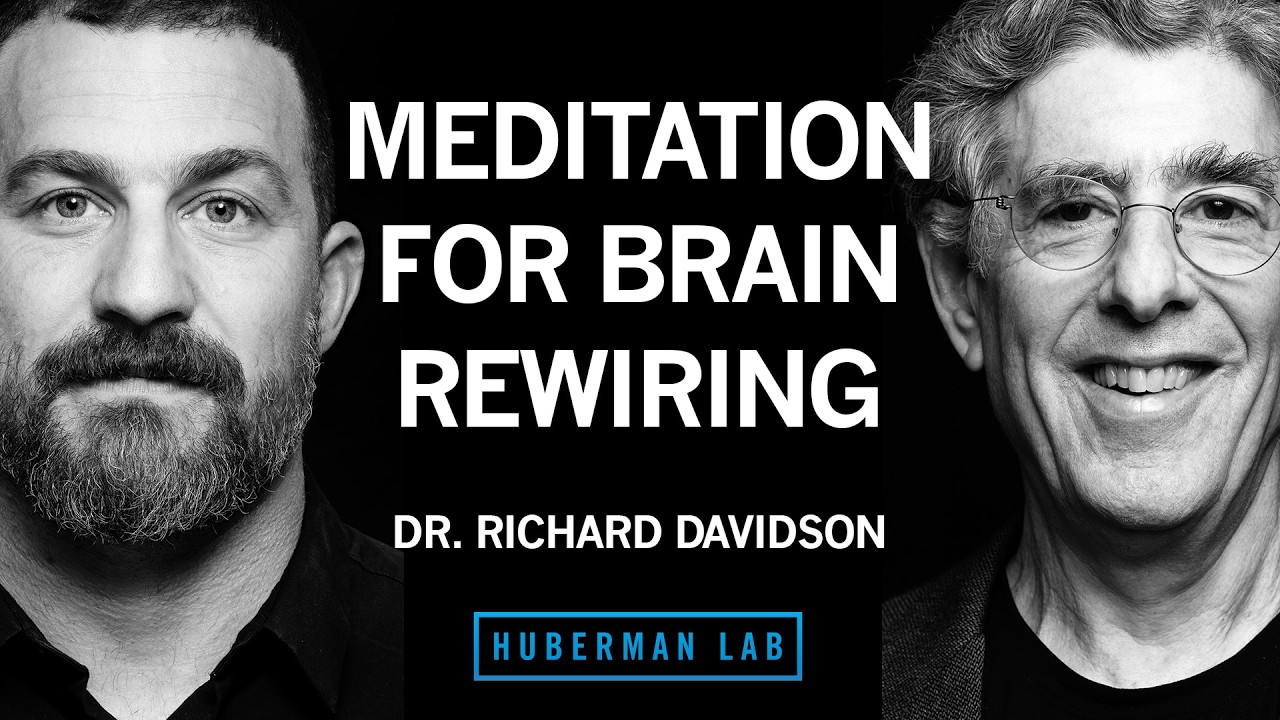
Science-Based Meditation Tools to Improve Your Brain & Health | Dr. Richard Davidson
Episode Summary
AI-generated · Mar 2026AI-generated summary — may contain inaccuracies. Not a substitute for the full episode or professional advice.
This episode features Dr. Richard Davidson, a pioneer in studying how meditation impacts the brain, during and over time, particularly in relation to neuroplasticity. Dr. Davidson, a professor of psychology and psychiatry at the University of Wisconsin-Madison, discusses the health and brain benefits of regular meditation, even in brief sessions. A key insight shared is that even five minutes of daily meditation for 30 days can significantly reduce symptoms of depression, anxiety, and stress, increase well-being, and decrease pro-inflammatory markers like IL6, a finding repeatedly shown in randomized control trials.
The conversation dispels common myths about meditation, clarifying that its purpose is not to clear the mind or achieve immediate inner peace, but to observe thoughts and stress. This observation process is likened to the burn in physical exercise, acting as a "lactate of the mind" that builds stress resilience, focus, and peacefulness outside of meditation. Dr. Davidson explains how the brain changes during various meditation types, including open monitoring, eyes-open, walking, seated, and standing practices. Host Andrew Huberman shares his personal experience, noting how implementing a 5-minute daily meditation for stress resilience, as described by Dr. Davidson, profoundly improved his mental clarity, focus, sleep, and stress levels.
The discussion also delves into the scientific understanding of "states of mind" versus "traits," introducing the concept that "the after is the before for the next during," illustrating how a state change can lead to a shift in baseline for subsequent experiences. Dr. Davidson educates listeners on different waking brain states, such as alpha, beta, theta, and the particularly interesting high-amplitude gamma activity observed in long-term meditators, which is associated with insight. He also categorizes meditation into broad bins like focused attention and open monitoring, emphasizing that meditation involves shifting from a mode of doing to simply being aware, without attempting to change or fix arising thoughts.
👤 Who Should Listen
- Mindfulness Practitioners
- Mental Health Advocates
- Anyone Struggling with Sleep
🔑 Key Takeaways
- 1.Consistent meditation of just five minutes a day for 30 days can lead to significant reductions in depression, anxiety, and stress symptoms, alongside increased well-being and reduced inflammation markers like IL6.
- 2.The purpose of meditation is not to clear the mind, but to observe thoughts and stress, which acts as a 'lactate of the mind' to build stress resilience and focus outside of the meditation practice.
- 3.The concept 'the after is the before for the next during' emphasizes that the lingering effects of one state, like meditation, establish the baseline for subsequent experiences and contribute to the development of lasting traits.
- 4.Different meditation types, such as focused attention (narrowing focus) and open monitoring (broadening awareness), have distinct impacts on the brain and body.
- 5.Long-term meditators exhibit remarkable high-amplitude gamma oscillations in the brain, which are associated with moments of insight and sustained awareness.
- 6.Shifting from a 'doing' to a 'being' mode in meditation means simply observing thoughts, rumination, or even sleepiness without attempting to change or fix them.
💬 Notable Quotes
“The after is the before for the next during.”
“Contrary to what most people believe, the point of meditation is not to clear your mind or to feel inner peace during the meditation, but rather to observe your thoughts and any stress you might experience during the meditation.”
“What really is most important is the invitation not to change it, not to actively try to shift it, but to simply be aware.”
More from this guest
Dr. Richard Davidson
Listen to Full Episode
📬 Get weekly summaries like this one
No spam. Unsubscribe anytime. By subscribing you agree to our Privacy Policy.
Continue Exploring