Found My Fitness
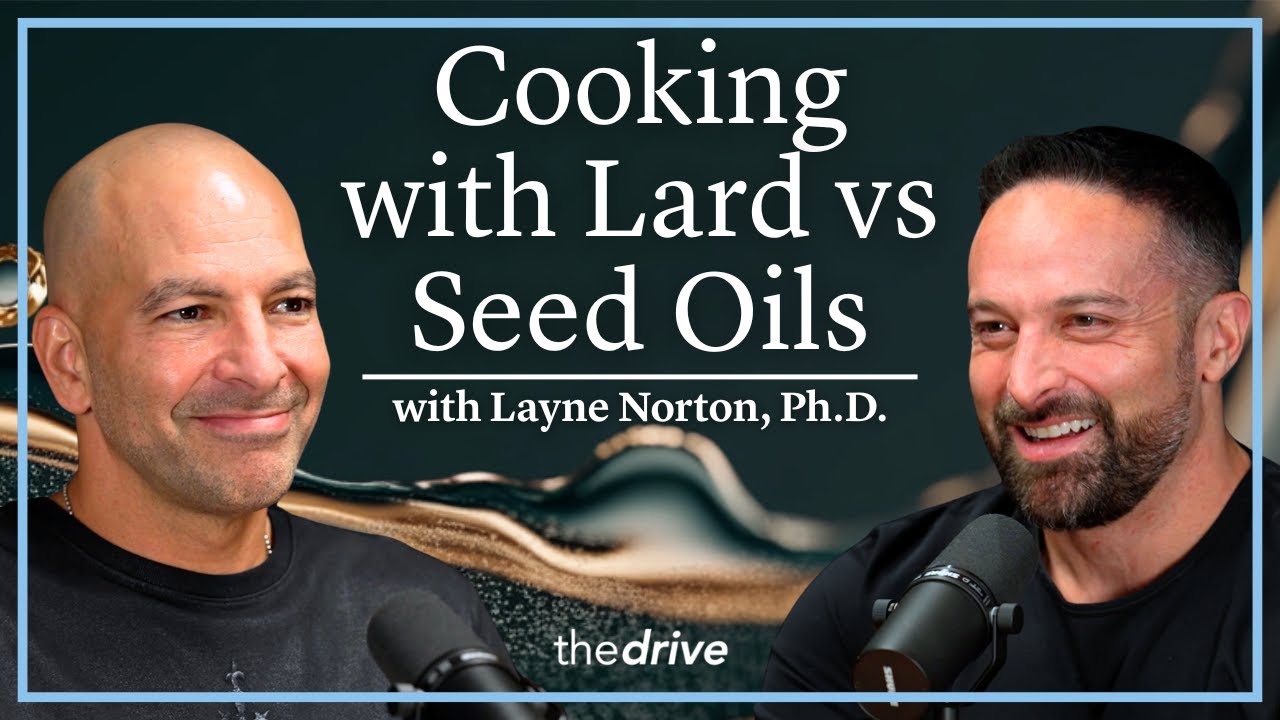
Cooking with Lard vs Seed Oils | Layne Norton, Ph.D.
Episode Summary
AI-generated · Mar 2026AI-generated summary — may contain inaccuracies. Not a substitute for the full episode or professional advice.
In this episode of Found My Fitness, Dr. Layne Norton, Ph.D., a prominent figure in nutrition science and evidence-based fitness, delves into the contentious debate surrounding seed oils versus saturated fats like lard, particularly in the context of cooking. He addresses the 'precautionary principle' often cited by those wary of seed oils, asserting that while one can avoid them, it's crucial to displace saturated fats with other options like monounsaturated fats (e.g., olive or avocado oil) that also offer cardiovascular benefits, albeit less than polyunsaturated fats.
Dr. Norton meticulously clarifies the nuances of oil oxidation, explaining that industrial processing of seed oils often occurs under vacuum, minimizing oxidation. However, he highlights that thin-layer frying in restaurants, especially with oil re-used repeatedly in vats, can lead to significant accumulation of oxidized trans fats within minutes. Confronted with the hypothetical choice of French fries cooked in lard versus seed oil, Dr. Norton unequivocally states, "Both are bad." He emphasizes that if one accepts French fries as an occasional indulgence, the choice between lard and seed oil for frying likely yields negligible differences in terms of overall health impact compared to the caloric density.
The conversation expands to critique the marketing tactics of food companies that pivot to ingredients like tallow or lard, not for genuine health improvement, but to capitalize on consumer trends, potentially leading the public to perceive these items as healthy and consume more. Dr. Norton cautions against the misinterpretation of scientific information, especially prevalent on social media where complex research is reduced to viral "hot takes" and sensationalized headlines, stripping away vital context. He stresses the importance of examining "converging lines of evidence" from high-quality, rigorously controlled studies, noting that even seemingly contradictory findings often make sense upon deeper review of study design and methodology.
Ultimately, Dr. Norton posits that focusing excessively on minor dietary details like the choice of frying oil for occasional treats is a distraction from larger, more impactful health levers. He highlights the stark reality of average American calorie consumption (3,500 calories/day) versus physical activity (less than 20 minutes/day). This imbalance, termed an "energy toxicity issue," is presented as a far greater driver of disease in developed countries than the specific fat used to fry French fries.
👤 Who Should Listen
- Anyone confused by conflicting dietary advice on seed oils versus traditional fats like lard.
- Individuals seeking a nuanced, evidence-based perspective on dietary fats and their health impacts.
- Health communicators and content creators interested in the challenges of conveying complex science to the public.
- People looking to understand the real priorities in driving overall health, beyond minor dietary tweaks.
- Consumers who want to critically evaluate marketing claims from food companies regarding 'healthy' ingredients.
- Listeners curious about the specific scientific mechanisms of oil oxidation and its relevance to cooking.
🔑 Key Takeaways
- 1.Avoiding seed oils is acceptable, but one should prioritize displacing saturated fats with other beneficial fats like monounsaturated oils (e.g., olive, avocado oil) to reduce LDL cholesterol.
- 2.Industrial processing of seed oils involves heating under vacuum, minimizing oxidation, but frying in thin layers or re-using oil in restaurants can rapidly lead to significant accumulation of oxidized products.
- 3.When comparing frying French fries in lard versus seed oil, Dr. Norton contends that "Both are bad" in terms of health, implying that the caloric density of the food itself is the primary concern.
- 4.Food companies' shifts to ingredients like tallow or lard are often marketing strategies that can mislead consumers into believing such products are 'healthy,' potentially encouraging overconsumption.
- 5.Social media "hot takes" on scientific studies frequently misrepresent findings by omitting crucial context, making it essential to consult original research and consider converging lines of evidence.
- 6.Focusing on the type of oil used for occasional French fries is "stepping over $100 bills picking up pennies" compared to addressing major health drivers like overall calorie consumption and physical activity.
- 7.Many diseases in developed countries are primarily driven by an "energy toxicity issue," characterized by high calorie intake and insufficient physical activity.
- 8.Understanding the limitations of studies is crucial, as no single study explains everything, and well-designed research relies on considering multiple lines of evidence to build confidence in conclusions.
💡 Key Concepts Explained
Precautionary Principle (in nutrition)
This is the idea that if there's a potential for harm from something, even without definitive proof, one should err on the side of caution and avoid it. Dr. Norton addresses this by saying that while individuals can choose to avoid seed oils, they should then actively replace saturated fats with other beneficial fats.
Energy Toxicity Issue
Dr. Norton uses this term to describe the fundamental problem driving disease in developed countries. It refers to the imbalance between high average calorie consumption (e.g., 3,500 calories/day in the U.S.) and extremely low physical activity (e.g., less than 20 minutes/day), leading to an excess of energy intake relative to expenditure.
Converging Lines of Evidence
This is a scientific framework emphasized by Dr. Norton for evaluating complex research questions. Instead of relying on a single study, it involves looking at the totality of evidence from various high-quality, rigorously controlled studies—including specific types like Mendelian randomization and statin trials—to build a robust understanding and confidence in conclusions.
⚡ Actionable Takeaways
- →If avoiding seed oils, actively seek out and increase consumption of monounsaturated fats like olive oil and avocado oil in your diet to displace saturated fat intake.
- →Be wary of frying foods at home or in restaurants using thin layers of oil or re-used oil, as this significantly increases the risk of oxidation and negative product formation.
- →Prioritize fundamental health behaviors like managing overall caloric intake and increasing physical activity, rather than fixating on minor dietary choices like the specific oil used for occasional treats.
- →Approach health claims, especially those on social media, with skepticism; always seek out the full context and original scientific studies rather than relying on sensationalized headlines.
- →Recognize that shifts by food companies to 'healthier' ingredients can be marketing ploys, and do not equate such changes with a license to consume more of those products.
- →Ensure your diet includes enough fiber and limit saturated fat, as these are more significant levers for health than narrowly focusing on seed oils.
- →Understand that occasional indulgence in hyper-caloric foods like French fries, regardless of the cooking fat, should be seen as such and not as a 'health victory' if cooked in alternative fats.
⏱ Timeline Breakdown
💬 Notable Quotes
“"When oil when these oils are in a large volume that the rate of oxidation is low even with heating...all the heating in the processing these oils is done under a vacuum which means there's no oxygen which means v virtually no chance for oxidation even when heated." [01:01]”
“"Both are bad, right?" [02:26]”
“"If I wanted to design a study to show no effect or the study to show an effect, easiest thing in the world." [07:37]”
“"We're stepping over $100 bills picking up pennies, you know?" [11:27]”
More from this guest
Layne Norton, Ph.D.
Listen to Full Episode
📬 Get weekly summaries like this one
No spam. Unsubscribe anytime. By subscribing you agree to our Privacy Policy.
Continue Exploring


