Found My Fitness
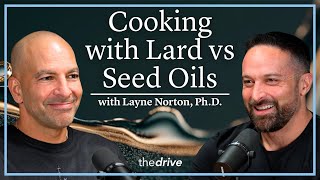
Why Ingredient Changes Don’t Always Mean Healthier Food | Layne Norton, Ph.D.

Episode Summary
AI-generated · Mar 2026AI-generated summary — may contain inaccuracies. Not a substitute for the full episode or professional advice.
Layne Norton, Ph.D., a respected nutrition scientist and founder of Biolayne, challenges the common assumption that ingredient changes in processed foods automatically translate to healthier products. He asserts that food companies are primarily driven by sales, not public health, and will readily pivot their ingredient lists—for instance, substituting seed oils with beef tallow or lard, or removing additives like red dye 40—to align with prevailing consumer sentiments and market their products as "healthier" (00:00).
Dr. Norton warns that without careful communication, consumers often misinterpret these changes as a green light to eat more of these products, believing them to be inherently more beneficial. He highlights the pervasive issue of misinformation on social media, where nutrition "hot takes" like "Five reasons why seed oils are toxic" gain significant traction by presenting elements of truth while deliberately omitting crucial context (01:02).
He addresses the common public sentiment of distrust in scientific research, where people perceive studies as contradictory and confusing. However, Dr. Norton argues that this distrust often stems from superficial engagement with information. He states that when people complain about conflicting studies, his first question is always, "Did you actually read the study or are you just looking at the social media hot takes?" (01:02).
Dr. Norton's personal experience shows that "99% of the time," when a headline or social media hot take seems nonsensical, reading the actual research clarifies the issue entirely (01:02, 02:03). This underscores the critical need for media literacy and a deeper dive into scientific literature to properly understand nutrition claims.
Listeners will walk away with a heightened skepticism toward food marketing tactics and a practical strategy for evaluating nutrition information: always question the source, consider the full context, and go beyond sensationalized headlines or social media snippets to understand the actual science.
👤 Who Should Listen
- Anyone interested in critical thinking about nutrition and health claims.
- Consumers who feel confused by conflicting dietary advice on social media.
- Individuals wanting to understand the motives behind food industry marketing tactics.
- People seeking to improve their scientific literacy regarding health and wellness research.
- Health-conscious individuals looking to navigate misinformation in the digital age.
🔑 Key Takeaways
- 1.Food companies are primarily motivated by sales, not consumer health, when making ingredient changes in their products.
- 2.Marketing shifts, such as replacing seed oils with tallow or removing red dye 40, are often strategic responses to public trends rather than a commitment to superior health outcomes.
- 3.Consumers frequently misinterpret ingredient modifications as a signal that foods are inherently healthier, potentially leading to increased consumption.
- 4.Social media 'hot takes' on nutrition, like "Five reasons why seed oils are toxic," often present partial truths but dangerously omit critical scientific context.
- 5.Perceived contradictions in scientific research are frequently resolved when individuals move beyond headlines and social media summaries to read the actual studies.
- 6.Layne Norton, Ph.D., finds that 99% of the time, confusion arising from nutrition headlines disappears after reviewing the full scientific paper.
⚡ Actionable Takeaways
- →Scrutinize marketing claims about new or changed ingredients in food products, recognizing that their primary driver is sales, not health.
- →Avoid making dietary decisions based solely on social media 'hot takes' about nutrition; always seek out the full scientific context.
- →When encountering seemingly contradictory scientific findings, prioritize reading the full study rather than relying on sensationalized headlines or summaries.
- →Be wary of content that simplifies complex nutrition topics into short, attention-grabbing lists without providing nuance.
- →Develop a habit of critical thinking when evaluating health and nutrition information, especially from platforms designed for rapid consumption.
⏱ Timeline Breakdown
💬 Notable Quotes
“"Food companies don't care. Okay. Well, we'll just make those then. That's fine."”
“"How do people navigate on social media? That's where it's really tough cuz it's not this, right? It's 30 seconds. How can I hook somebody in? Five reasons why seed oils are toxic, right?"”
“"Did you actually read the study or are you just looking at the social media hot takes? Because my guess is you're probably looking at the hot takes."”
“"99 times out of a 100, I walk out going, 'Oh, okay.'"”
More from this guest
Layne Norton, Ph.D.
Listen to Full Episode
📬 Get weekly summaries like this one
No spam. Unsubscribe anytime. By subscribing you agree to our Privacy Policy.
Continue Exploring