Found My Fitness
How Busy Moms Can Build Strength and Cardio Fitness | Abbie Smith-Ryan, Ph.D.
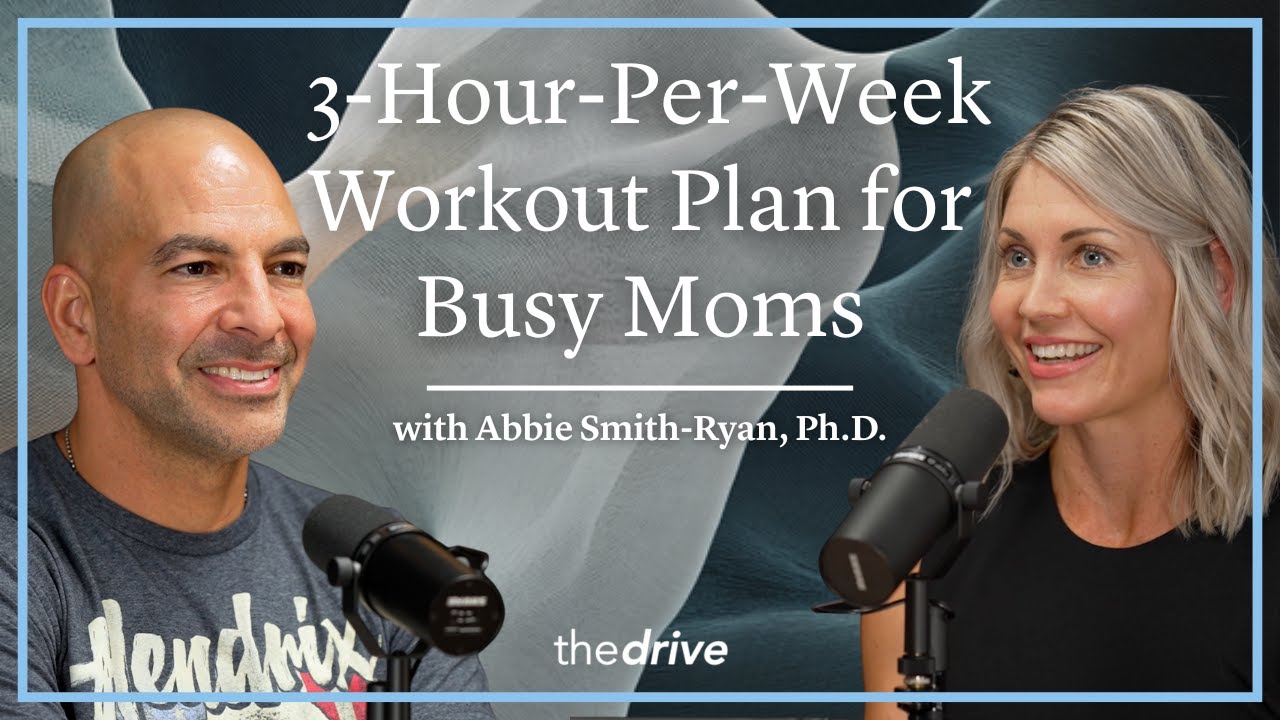
Episode Summary
AI-generated · Mar 2026AI-generated summary — may contain inaccuracies. Not a substitute for the full episode or professional advice.
In this episode, Dr. Abbie Smith-Ryan, a prominent researcher in exercise physiology, provides highly specific and time-efficient fitness strategies for busy individuals, particularly midlife women and mothers with limited training availability. The central thesis is that significant strength and cardiovascular fitness improvements are achievable even with as little as three hours per week dedicated to exercise, moving beyond the luxury of extensive training schedules to practical, impactful protocols.
Dr. Smith-Ryan outlines a clear framework for allocating training time: one hour for resistance training and two hours for cardiovascular exercise, within a three-hour weekly total. For resistance, she recommends two 30-minute whole-body progressive sessions per week, emphasizing higher intensity. A specific protocol discussed involves 30-minute sessions with 6-8 repetitions (60-80% of 1RM), 30 seconds rest between exercises, and 2 minutes rest between circuits. This approach prioritizes muscle building and strength, crucial for midlife health.
For cardiovascular fitness, Dr. Smith-Ryan advocates for two to three days of aerobic exercise, ideally with two of those being high-intensity interval training (HIIT). She details a highly effective HIIT protocol: 10 sets of 1 minute 'on' followed by 1 minute 'off.' The 'on' minute should be at an intensity where one couldn't sustain it for 1 minute 20 seconds, translating to roughly 90-110% of max effort. While acknowledging that measuring VO2 max or max heart rate is impractical for most, the conversation highlights the importance of perceived exertion (RPE) to guide these intense efforts, noting that benefits still accrue even if exact maximums aren't hit.
The discussion also touches upon integrating lower-intensity movement for overall well-being and blood flow, especially on days with more time. Dr. Smith-Ryan stresses that prioritizing high-intensity training not only boosts cardiovascular health but also aids in increasing lean muscle mass, which is particularly beneficial for midlife women. Listeners will walk away with a precise, actionable blueprint for structuring a highly effective fitness regimen within a demanding schedule, making strength and cardio gains accessible and sustainable.
👤 Who Should Listen
- Busy parents looking for effective fitness strategies with limited time.
- Midlife women seeking to improve strength, cardio, and lean muscle mass.
- Individuals with only 3 hours per week available for exercise.
- Anyone interested in highly structured, time-efficient resistance and high-intensity interval training protocols.
- People who want to understand how to apply fitness principles without access to lab equipment or extensive training time.
🔑 Key Takeaways
- 1.For those with limited time, such as busy moms, prioritizing a few days a week of whole-body progressive resistance training is crucial for overall fitness.
- 2.A time-efficient resistance training protocol involves two 30-minute sessions per week, with 6-8 reps at 60-80% 1RM, 30 seconds rest between exercises, and 2 minutes rest between sets.
- 3.Cardiovascular training should include at least one, and ideally two, high-intensity interval training (HIIT) sessions per week for maximum benefit.
- 4.An effective HIIT protocol consists of 10 sets of 1 minute 'on' at a very high intensity (one that cannot be sustained for 1 minute 20 seconds), followed by 1 minute 'off'.
- 5.While lab measurements like VO2 max are ideal, guiding HIIT efforts by perceived exertion (RPE) is a practical and effective alternative for the general population.
- 6.Even if specific intensity targets are not perfectly met, consistent high-intensity interval training will still yield significant fitness benefits over time.
- 7.Splitting exercise into shorter, more manageable 30-minute sessions multiple times a week can be more sustainable and beneficial than fewer, longer sessions, especially for midlife women needing daily movement.
💡 Key Concepts Explained
Time-Efficient Resistance Training Protocol
This framework offers a condensed yet effective way to build strength. It involves 30-minute whole-body sessions, using 6-8 repetitions at 60-80% of one-rep max (1RM), with short rest periods of 30 seconds between exercises and 2 minutes between circuits. This protocol is highlighted as being highly feasible for busy individuals to achieve progressive overload.
1-Minute On/1-Minute Off HIIT Protocol
A high-intensity interval training (HIIT) method recommended for cardiovascular fitness, especially when time is limited. It consists of up to 10 sets where participants work intensely for one minute (at 90-110% of maximum effort, or an intensity that can't be held for 1 minute 20 seconds), followed by one minute of rest. This protocol is lauded for its feasibility, effectiveness in improving fitness, and even its capacity to increase lean mass.
⚡ Actionable Takeaways
- →Dedicate two 30-minute sessions per week to whole-body resistance training, focusing on progressive overload.
- →Implement the suggested resistance training protocol: 6-8 reps (60-80% 1RM), 30 seconds rest between exercises, 2 minutes rest between sets for time efficiency.
- →Integrate at least one, preferably two, high-intensity interval training (HIIT) sessions into your weekly cardio routine.
- →Try the 1 minute 'on' / 1 minute 'off' HIIT protocol for up to 10 rounds, ensuring the 'on' minute is at an intensity that you couldn't maintain for 80 seconds.
- →When performing HIIT, focus on your rate of perceived exertion (RPE) rather than solely relying on heart rate monitors, especially for short, intense intervals.
- →On days with more time, incorporate low-intensity movement like walking or cycling to promote blood flow and overall well-being.
⏱ Timeline Breakdown
💬 Notable Quotes
“"I would absolutely prioritize a few days a week of whole body progressive resistance training."”
“"The protocol that's been very effective for us in very fit individuals down to cancer individuals is 10 sets of 1 minute on 1 minute off."”
“"You pick an intensity that one minute is really hard and you need to take a break."”
“"The goal of the interval style training if you're doing it without like you know in a lab is that you'll still see benefits even if you're not necessarily hitting that 90%."”
More from this guest
Abbie Smith-Ryan, Ph.D.
Listen to Full Episode
📬 Get weekly summaries like this one
No spam. Unsubscribe anytime. By subscribing you agree to our Privacy Policy.
Continue Exploring


