Huberman Lab
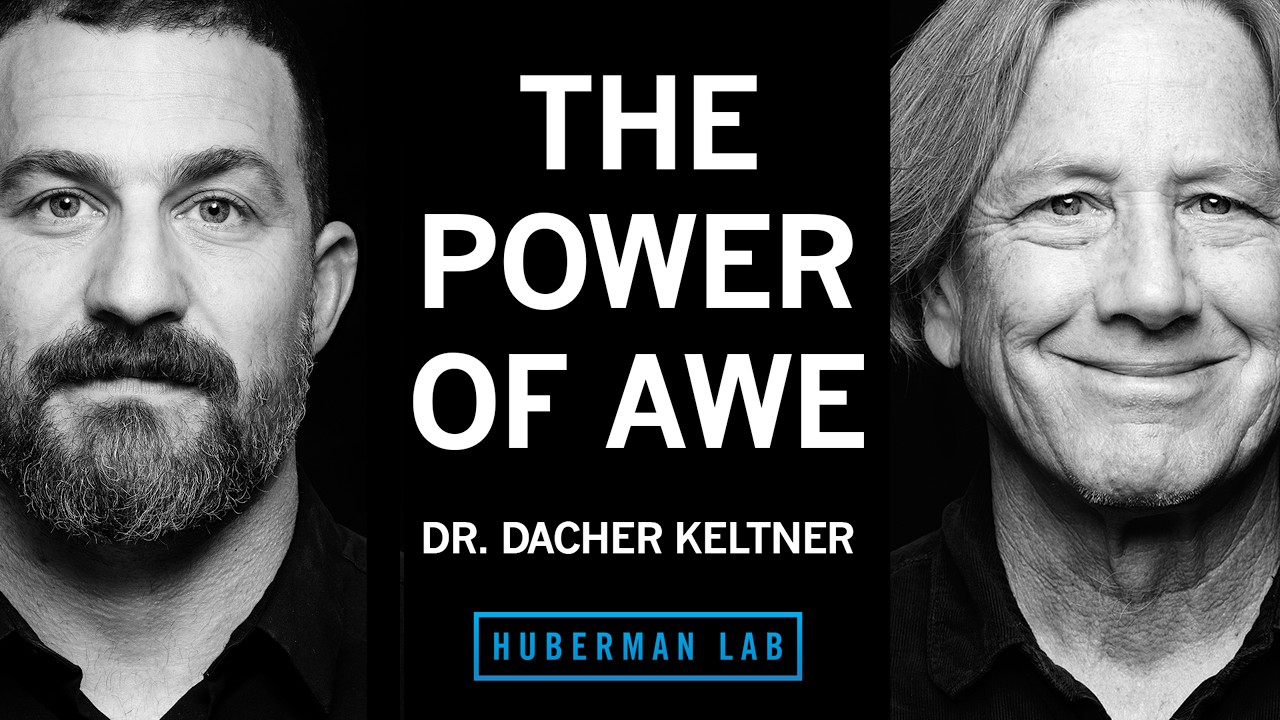
Cultivating Awe & Emotional Connection in Daily Life | Dr. Dacher Keltner
Episode Summary
AI-generated · Apr 2026AI-generated summary — may contain inaccuracies. Not a substitute for the full episode or professional advice.
Dr. Dacher Keltner, a distinguished professor of psychology and co-director of the Greater Good Science Center at UC Berkeley, joins Dr. Andrew Huberman to explore the profound science of emotions, with a particular focus on awe and its transformative power. Keltner, known for his rigorous and creative research, explains that awe is not an elusive state but rather a fundamental human experience occurring when our perception shifts from a very small scale to a very large scale, or back again. The conversation delves into the physiological benefits of awe, such as reduced inflammation, elevated vagal tone, and even alleviation of long COVID symptoms, positioning awe as a potent, everyday tool for enhanced well-being.
👤 Who Should Listen
- Anyone seeking science-based tools to enhance their emotional well-being and daily life.
- Individuals interested in the physiological and psychological benefits of positive emotions like awe.
- People looking for practical strategies to cultivate a sense of wonder and connection in their routine.
- Those curious about the science behind social dynamics, bonding, and emotional expression.
- Listeners concerned about the impact of social media and self-focus on mental health and community.
- Anyone wanting to understand the broader taxonomy of human emotions beyond basic categories.
🔑 Key Takeaways
- 1.Awe is a powerful emotion that can reduce inflammation, elevate vagal tone, and even alleviate long COVID symptoms, making it a valuable tool for physical and mental health [00:00, 33:45].
- 2.Awe is not elusive but arises from shifting one's perception from a small scale to a very large scale, such as encountering a new horizon or visual vista [01:00, 27:36].
- 3.Emotional science has expanded beyond the initial six basic emotions to identify approximately 20 distinct facial expressions, including awe, laughter, love, and embarrassment, with 50-60% of these expressions being hardwired across cultures [06:06, 08:12].
- 4."Awe walks," which involve slowing down, deepening breathing, and intentionally shifting visual focus from small details to vast patterns, can lead to increased kindness, reduced physical pain, and improved brain health, particularly in older adults [29:41, 32:45].
- 5.Awe connects individuals to something vast and transcendent—be it evolution, nature, a cultural movement, or a group—fostering a sense of belonging and equanimity rather than merely self-forgetfulness [40:54, 41:55].
- 6.Benevolent teasing and embarrassment, when occurring within a trusted collective, serve as crucial mechanisms for social bonding by signaling commitment to group norms and fostering liking and trust among members [97:07, 100:09].
- 7.Self-focus, often exacerbated by certain chemical states or the design of social media, acts as a significant inhibitor of awe, contrasting with awe's ability to quiet the self and foster collective connection [71:29, 72:30].
- 8.Shared experiences like concerts, sporting events, and collective wellness activities (e.g., saunas, breathwork) facilitate brain synchronization and a sense of collective effervescence, which are powerful sources of awe and community bonding [48:04, 49:07, 80:45].
💡 Key Concepts Explained
Small-to-Vast Perception Shift in Awe
This is a core mechanism of awe, where an individual's perception shifts from a focused, small-scale view to an expansive, large-scale view. Dr. Keltner emphasizes that this fundamental shift makes awe accessible and cultivable in everyday life, rather than being an elusive or purely spiritual experience [01:00, 27:36].
Embarrassment as a Social Signal
The motor pattern of embarrassment (blushing, averted gaze, hiding the face) acts as a non-verbal signal of commitment to group norms and an implicit apology for transgressions. Dr. Keltner's research demonstrates that this reframes embarrassment not as a weakness, but as a vital social glue that fosters trust and liking within groups [97:07, 98:07].
Temporal Distancing (in Awe)
A phenomenon where awe helps individuals transcend immediate self-concerns by embedding them within larger historical, evolutionary, or personal narratives, connecting present moments to vast time scales encompassing past and future. Dr. Keltner notes that this process fosters equanimity and a sense of being part of something vast [38:52, 41:55].
Collective Effervescence
A term originally coined by Émile Durkheim, described in this episode as the shared emotional intensity and brain synchronization that occurs in groups during collective activities like music concerts, sports events, or rituals. Dr. Keltner and Huberman highlight it as a powerful pathway for deep human bonding and a significant source of awe [49:07].
⚡ Actionable Takeaways
- →Engage in a daily "awe minute" by consciously observing your environment and allowing your perception to shift from small details to vast patterns, which Keltner notes can reduce long COVID symptoms and inflammation [00:00, 33:45].
- →Practice "awe walks" at least once a week by going to a place that may surprise you, slowing your pace, deepening your breathing, and intentionally expanding your visual focus from specific objects (like a leaf) to broader patterns (like a canopy of leaves or clouds) [29:41, 32:45].
- →Seek out experiences that promote a visual transformation from a confined space to an open horizon, as this shift is cited as a fundamental trigger for awe and parasympathetic relaxation [26:35].
- →Participate in shared collective experiences, such as live music concerts, sporting events, or community gatherings, to foster brain synchronization and a deep sense of connection, which are identified as powerful sources of awe [48:04, 49:07].
- →Observe your own and others' embarrassment in social interactions, recognizing it as a signal of commitment and apology, which Keltner's research suggests can strengthen social bonds and build trust [97:07, 98:07].
- →Be mindful of environments or activities that foster excessive self-focus, such as certain social media habits or substances like cocaine, as Keltner and Huberman explain these can actively inhibit the experience of awe [68:28, 71:29, 82:48].
⏱ Timeline Breakdown
💬 Notable Quotes
“"awe is not elusive. It happens when we shift our perception from a very small scale to a very large scale or back again, such as when we suddenly reach a new horizon or visual vista." [01:00]”
“"You feel small and quiet, but part of something really large." [23:30]”
“"all mean egotism vanishes." [71:29]”
“"Cuz cocaine's all about me. It's the me drug." [68:28]”
More from this guest
Dr. Dacher Keltner
📚 Books Mentioned
Listen to Full Episode
📬 Get weekly summaries like this one
No spam. Unsubscribe anytime. By subscribing you agree to our Privacy Policy.
Continue Exploring