Huberman Lab
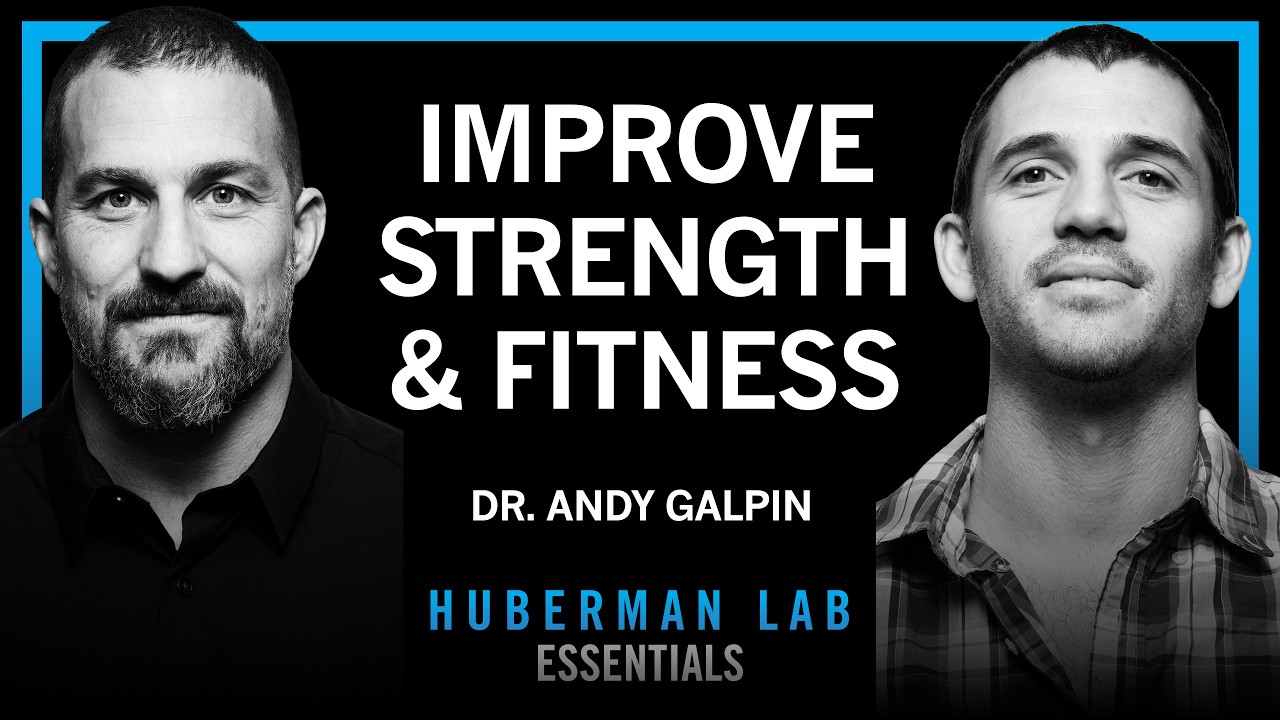
Essentials: How to Build Strength, Muscle Size & Endurance | Dr. Andy Galpin
Episode Summary
AI-generated · Apr 2026AI-generated summary — may contain inaccuracies. Not a substitute for the full episode or professional advice.
In this Huberman Lab Essentials episode, Dr. Andy Galpin, a highly trusted expert in exercise physiology, joins Dr. Andrew Huberman to provide potent, actionable science-based tools for building strength, muscle size (hypertrophy), and endurance. Dr. Galpin lays out the fundamental principles underlying all exercise adaptations, emphasizing that while there are nine distinct types of adaptations—from skill and speed to strength, hypertrophy, and various forms of endurance—successful training hinges on understanding how to manipulate key variables to achieve specific outcomes. He highlights that some adaptations can even be contrarian, meaning pushing for one might sacrifice another.
Dr. Galpin details the six modifiable variables in any workout that dictate results: exercise choice, intensity (defined as a percentage of one-rep max or max heart rate, not perceived effort), volume (sets x reps), rest intervals, progression (progressive overload), and training frequency. He explains that progressive overload, achieved through adding weight, reps, frequency, or complexity, is non-negotiable for continuous improvement. For strength development, the focus is on high intensity (above 85% of 1RM for trained individuals, 75% for moderately trained) and low reps (five or less), with two to four minutes of rest to maintain intensity. In contrast, hypertrophy is primarily driven by total volume (around 10-20 working sets per muscle group per week), training to muscular failure within a broad range of 5 to 30 repetitions, and allowing 48 to 72 hours for recovery to support protein synthesis.
A critical insight from Dr. Galpin is the power of intentionality and the "mind-muscle connection." He cites research showing that the *intent* to move a weight faster, even if the actual speed is the same, leads to greater strength gains. Similarly, actively focusing on contracting the target muscle during hypertrophy training can lead to more growth. He introduces the "three to five concept" as a flexible guideline for strength and power training: 3-5 exercises, 3-5 reps, 3-5 sets, 3-5 minutes rest, and 3-5 times a week, with intensity being the primary differentiator between strength and power.
Finally, the discussion delves into practical advice for muscle activation, such as eccentric overload for difficult-to-target groups, and emphasizes the overlooked importance of post-workout recovery. Dr. Huberman shares his personal success with Dr. Galpin’s recommendation of a three-to-five-minute post-workout downregulation protocol involving nasal breathing with an emphasized exhale (e.g., 4-second inhale, 8-second exhale), noting significant improvements in recovery rate and avoidance of afternoon energy dips. Listeners will walk away with a comprehensive, evidence-based framework for designing and executing training programs tailored to their specific fitness goals, along with concrete strategies for optimizing performance and recovery.
👤 Who Should Listen
- Anyone looking to optimize their strength, muscle size, or endurance training.
- Individuals who want to understand the scientific principles behind effective exercise programming.
- Beginners seeking clear, actionable guidelines for starting or improving a resistance training program.
- Experienced lifters or athletes aiming to refine their training variables for specific performance goals.
- People interested in practical strategies for improving muscle activation and preventing injury.
- Anyone looking for evidence-based methods to enhance post-workout recovery and overall physiological well-being.
🔑 Key Takeaways
- 1.Exercise can yield nine distinct adaptations—skill, speed, power, strength, hypertrophy, muscular endurance, anaerobic power, V2 max, and long-duration endurance—some of which are complementary while others are contrarian (01:01).
- 2.Continuous physiological improvement is impossible without progressive overload, which can be achieved by increasing weight, repetitions, frequency, or movement complexity (03:04).
- 3.Training outcomes are determined by manipulating six modifiable variables: exercise choice, intensity (percentage of 1RM or max heart rate), volume (sets x reps), rest intervals, progression, and frequency (04:05).
- 4.Strength development primarily requires high intensity (above 85% of 1RM for trained individuals) and low repetitions (five or less per set), with long rest periods (2-4 minutes) to maintain force output (11:12).
- 5.Hypertrophy (muscle size) is mainly driven by total volume (aiming for 10-20 working sets per muscle group per week) and taking sets to muscular failure within a broad range of 5 to 30 repetitions, with 48-72 hours of recovery (18:23).
- 6.The “three to five concept” offers a flexible framework for strength and power training, suggesting 3-5 exercises, 3-5 reps, 3-5 sets, 3-5 minutes rest, 3-5 times per week, with intensity differentiating strength from power (22:28).
- 7.Intentionality and the “mind-muscle connection” significantly enhance training adaptation; focusing on moving weight fast improves strength, while focusing on muscle contraction improves hypertrophy, even if external factors are constant (24:30).
- 8.Implementing a 3-5 minute post-workout downregulation protocol with emphasized exhales, such as 4-second inhale/8-second exhale nasal breathing, dramatically improves recovery and prevents energy crashes (30:35).
- 9.Soreness is a poor indicator of workout quality, and excessive soreness can be detrimental by forcing missed training sessions, thereby reducing overall training volume (06:08).
💡 Key Concepts Explained
Nine Exercise Adaptations
This framework categorizes the various physiological outcomes achievable through exercise: skill, speed, power, strength, hypertrophy (muscle size), muscular endurance, anaerobic power, V2 max, and long-duration endurance. The episode highlights that understanding these distinct adaptations is crucial because some are complementary while others can be contrarian, meaning training for one may compromise another (01:01).
Progressive Overload
This fundamental principle states that to continue improving in any fitness adaptation, the body must be exposed to continually increasing stress. Without progressive overload—achieved by adding weight, reps, frequency, or complexity—adaptation will cease, and only maintenance will occur. Dr. Galpin emphasizes this as a non-negotiable for sustained progress (03:04).
Modifiable Variables
These are the six key parameters within a workout that, when adjusted, will alter the training outcome: exercise choice, intensity (percentage of 1RM or max heart rate), volume (sets x reps), rest intervals, progression, and frequency. The episode explains that manipulating these variables is how one can specifically target different adaptations like strength versus hypertrophy (04:05).
Mind-Muscle Connection
This concept refers to the conscious focus on contracting the target muscle during an exercise or intending to move a weight with maximum speed. The episode cites scientific evidence indicating that this intentionality, even if the external movement is identical, can lead to greater adaptations in both strength and hypertrophy, underscoring the importance of being present and focused during training (25:31).
Three to Five Concept
This is a flexible, broad guideline for strength and power training that allows for individual variability based on daily feeling, time, and soreness. It suggests performing 3-5 exercises, for 3-5 repetitions per set, 3-5 sets per exercise, with 3-5 minutes of rest in between, 3-5 times per week. The primary differentiator between strength and power within this framework is the intensity (weight percentage) used (22:28).
Eccentric Overload
This training technique focuses on the lowering or lengthening phase of a movement, often used to activate and strengthen difficult-to-target muscle groups. Dr. Galpin explains that by breaking down a movement and focusing on a controlled eccentric phase (e.g., slowly lowering during a pull-up), individuals can improve muscle awareness, control, and eventually integrate activation into the full movement (28:34).
⚡ Actionable Takeaways
- →Implement progressive overload in your training by consistently increasing weight, repetitions, training frequency, or movement complexity (03:04).
- →For strength, perform 2-3 working sets of 5 repetitions or less, using weights above 85% of your one-rep max, and take 2-4 minutes of rest between sets (12:14).
- →For hypertrophy, aim for 10-20 working sets per muscle group per week, taking each set to muscular failure within a 5-30 rep range, and allow 48-72 hours of recovery for each muscle group (18:23).
- →Actively focus your mind during training: for strength, intend to move the weight as fast as possible; for hypertrophy, consciously contract the target muscle (24:30).
- →Utilize eccentric overload (e.g., slowly lowering yourself during a pull-up) to activate and strengthen difficult-to-target muscle groups and improve movement control (28:34).
- →Adopt a consistent breathing strategy during lifts, generally maintaining a breath hold during the eccentric (lowering) phase and exhaling during the concentric (lifting) phase (29:35).
- →Practice a 3-5 minute post-workout downregulation by nasal breathing with an emphasized exhale (e.g., twice as long as the inhale) to accelerate recovery and prevent energy dips (30:35).
⏱ Timeline Breakdown
💬 Notable Quotes
“"Adaptation physiologically happens as a byproduct of stress. So you have to push a system." [03:04]”
“"The total driver of strength is intensity but the total driver of hypertrophy is volume assumed you're taking it to fatigue..." [18:23]”
“"The intent to move is actually more important than the actual movement velocity." [24:30]”
“"The mind body connection are going to result in more growth than not." [26:32]”
More from this guest
Dr. Andy Galpin
Listen to Full Episode
📬 Get weekly summaries like this one
No spam. Unsubscribe anytime. By subscribing you agree to our Privacy Policy.
Continue Exploring