Topic
Best Fitness Podcast Episodes
Fitness is covered across 14 podcast episodes in our library, spanning 9 shows and 8 expert guests — including Huberman Lab, SmartLess, Modern Wisdom. Conversations explore core themes like autoregulation for rest, nine exercise adaptations, progressive overload, drawing on firsthand experience and research from leading practitioners.
Below you'll find key insights, core concepts, and actionable advice aggregated from the top episodes — followed by a ranked list of the best fitness discussions to explore next.
Key Insights on Fitness
- 1.Exercise can yield nine distinct adaptations—skill, speed, power, strength, hypertrophy, muscular endurance, anaerobic power, V2 max, and long-duration endurance—some of which are complementary while others are contrarian (01:01).
- 2.Continuous physiological improvement is impossible without progressive overload, which can be achieved by increasing weight, repetitions, frequency, or movement complexity (03:04).
- 3.Training outcomes are determined by manipulating six modifiable variables: exercise choice, intensity (percentage of 1RM or max heart rate), volume (sets x reps), rest intervals, progression, and frequency (04:05).
- 4.Strength development primarily requires high intensity (above 85% of 1RM for trained individuals) and low repetitions (five or less per set), with long rest periods (2-4 minutes) to maintain force output (11:12).
- 5.Hypertrophy (muscle size) is mainly driven by total volume (aiming for 10-20 working sets per muscle group per week) and taking sets to muscular failure within a broad range of 5 to 30 repetitions, with 48-72 hours of recovery (18:23).
- 6.The “three to five concept” offers a flexible framework for strength and power training, suggesting 3-5 exercises, 3-5 reps, 3-5 sets, 3-5 minutes rest, 3-5 times per week, with intensity differentiating strength from power (22:28).
Key Concepts in Fitness
Autoregulation for rest
Dr. Colenso-Semple suggests resting for 2-3 minutes between sets for general training, or longer (4-5 minutes) for strength-specific goals, allowing individuals to adjust based on how they feel and their ability to maintain performance [25:25].
Nine exercise adaptations
This framework categorizes the various physiological outcomes achievable through exercise: skill, speed, power, strength, hypertrophy (muscle size), muscular endurance, anaerobic power, V2 max, and long-duration endurance. The episode highlights that understanding these distinct adaptations is crucial because some are complementary while others can be contrarian, meaning training for one may compromise another (01:01).
Progressive overload
This fundamental principle states that to continue improving in any fitness adaptation, the body must be exposed to continually increasing stress. Without progressive overload—achieved by adding weight, reps, frequency, or complexity—adaptation will cease, and only maintenance will occur. Dr. Galpin emphasizes this as a non-negotiable for sustained progress (03:04).
Modifiable variables
These are the six key parameters within a workout that, when adjusted, will alter the training outcome: exercise choice, intensity (percentage of 1RM or max heart rate), volume (sets x reps), rest intervals, progression, and frequency. The episode explains that manipulating these variables is how one can specifically target different adaptations like strength versus hypertrophy (04:05).
Actionable Takeaways
- ✓Implement progressive overload in your training by consistently increasing weight, repetitions, training frequency, or movement complexity (03:04).
- ✓For strength, perform 2-3 working sets of 5 repetitions or less, using weights above 85% of your one-rep max, and take 2-4 minutes of rest between sets (12:14).
- ✓For hypertrophy, aim for 10-20 working sets per muscle group per week, taking each set to muscular failure within a 5-30 rep range, and allow 48-72 hours of recovery for each muscle group (18:23).
- ✓Actively focus your mind during training: for strength, intend to move the weight as fast as possible; for hypertrophy, consciously contract the target muscle (24:30).
- ✓Utilize eccentric overload (e.g., slowly lowering yourself during a pull-up) to activate and strengthen difficult-to-target muscle groups and improve movement control (28:34).
Top Episodes — Ranked by Insight (showing 10 of 14)
View all 14 →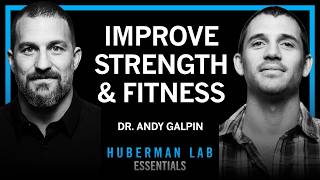
Huberman Lab
Essentials: How to Build Strength, Muscle Size & Endurance | Dr. Andy Galpin
Exercise can yield nine distinct adaptations—skill, speed, power, strength, hypertrophy, muscular endurance, anaerobic power, V2 max, and long-duration endurance—some of which are complementary while others are contrarian (01:01).

Huberman Lab
The Most Effective Weight Training, Cardio & Nutrition for Women | Dr. Lauren Colenso-Semple
Men and women respond very similarly to exercise at the cellular and growth levels, with primary differences stemming from baseline testosterone levels established during puberty, not differing muscle physiology [03:02].
Huberman Lab
The Most Effective Weight Training, Cardio & Nutrition for Women | Dr. Lauren Colenso-Semple
Men and women exhibit very similar muscle protein metabolism and growth responses to exercise, meaning fundamental training principles for building muscle and strength are universal.

SmartLess
STAYING ALIVE: Will Arnett, Part 1!
Will Arnett initiated a significant health transformation 18 months ago, driven by his agent's recommendation to see a nutritionist and the increasing difficulty of maintaining fitness over 50.

Modern Wisdom
Listen to Michael B. Jordan Before He Won an Oscar
Michael B. Jordan's role as Oscar Grant in *Fruitvale Station* served as his "coming out party" [01:00] and provided a crucial platform to address ongoing issues of racial injustice [03:50].

The Tim Ferriss Show
This Workout Protects Your Brain For Years
Norwegian 4x4 high-intensity training involves four rounds of 4 minutes at near-maximal heart rate (Zone 4) followed by 3 minutes of active rest.

Found My Fitness
How Early Training Choices Shape Women’s Health for Life | Abbie Smith-Ryan, Ph.D.
Bone density for women peaks around age 19, making childhood and adolescence crucial periods for building a strong skeletal foundation to prevent osteoporosis.

Diary of a CEO
STOP TOUCHING RECEIPTS IMMEDIATELY! 😱
Everyday products, from art supplies to kitchen plastics and receipts, can contain disrupting chemicals that negatively impact health.

Found My Fitness
Why Higher VO₂ Max is Important | Peter Attia
VO₂ max naturally declines with age, but the oxygen demands of desired physical activities remain constant.

Found My Fitness
How Women Can Balance Strength and Cardio With Limited Time | Abbie Smith-Ryan, Ph.D.
Prioritize a few days a week of whole-body progressive resistance training, even with a total of only 3 hours per week for exercise.
Episodes ranked by insight density — scored on key takeaways, concepts explained, and actionable advice. AI-generated summaries; listen to full episodes for complete context.