Huberman Lab
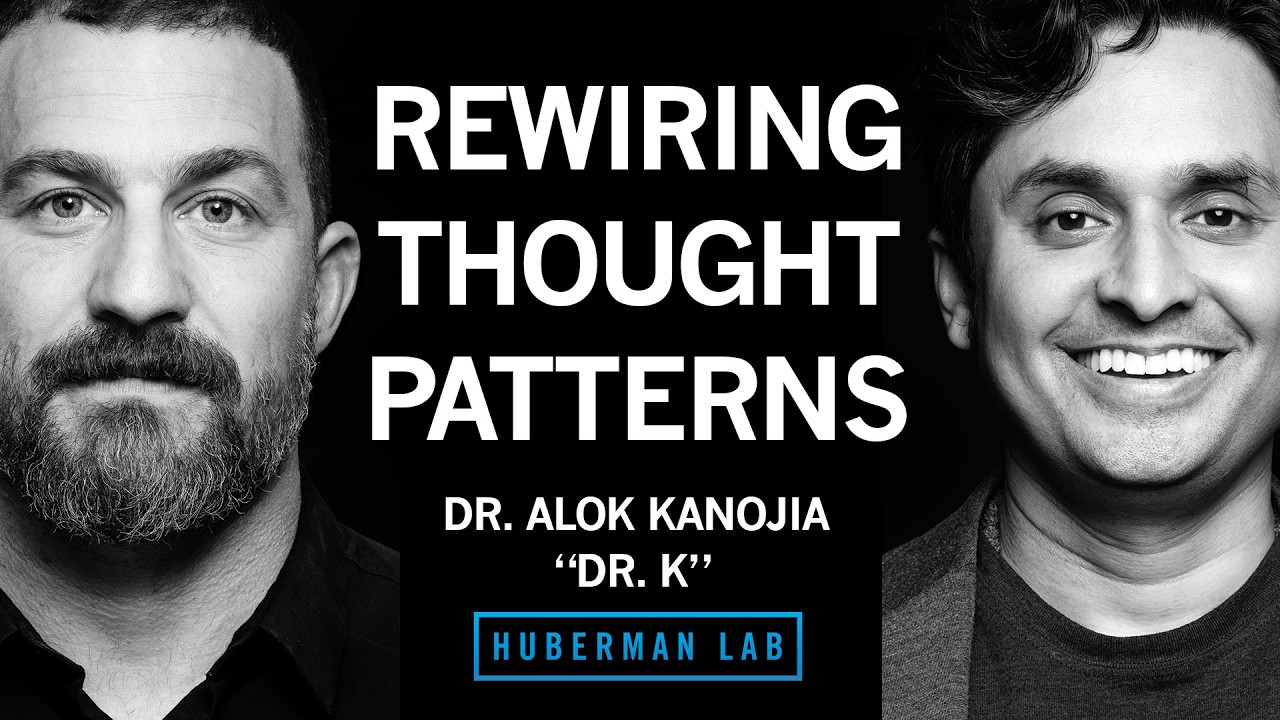
Unlearn Negative Thoughts & Behaviors Patterns | Dr. Alok Kanojia (Healthy Gamer)
Episode Summary
AI-generated · Mar 2026AI-generated summary — may contain inaccuracies. Not a substitute for the full episode or professional advice.
In this episode of the Huberman Lab podcast, Dr. Andrew Huberman hosts Dr. Alok Kanojia, also known as Dr. K from Healthy Gamer, a psychiatrist and online mental health educator with a unique background that includes training as a monk. The conversation focuses on powerful tools to improve self-understanding and mental health by rewiring the nervous system to unlearn unhealthy thought and behavior patterns. Dr. K emphasizes changing underlying tendencies rather than solely relying on willpower, drawing parallels to psychotherapy where personality disorders and trauma can be resolved by shifting self-esteem and self-concept.
The discussion delves into Dr. K's personal history, including his experience as a gifted child who became addicted to video games due to the lack of appropriate cognitive pacing in school and intense academic pressure from his first-generation immigrant parents, both doctors. He explains how this led to him failing out of college before eventually finding his path. The episode critically examines the modern mental health landscape, particularly the impact of increased awareness of feelings and trauma. Dr. K suggests that while awareness is good, "therapy speak" can be hijacked by the ego, leading to manipulative uses of concepts like "boundaries" and a tendency towards victimization.
A significant point of discussion is the concept of distress tolerance—the human capacity to sit with discomfort—which Dr. K notes is declining and correlated with an explosion of mental illnesses. He argues that negative emotions like anxiety and embarrassment serve crucial biological and social functions; for example, embarrassment signals empathy and awareness of wrongdoing, making interactions safer. The conversation also touches on the nature of ambiguity in human interactions, particularly flirting, suggesting it's a natural and even necessary component for preserving plausible deniability and safety, rather than a problem to be solved. Dr. K highlights misdiagnosis as a major issue, especially for high-performers, where symptoms like anxiety might mask deeper problems like unhappiness with one's environment.
👤 Who Should Listen
- Mental Health Advocates
- Creators & Social Media Professionals
- Health Enthusiasts
- Science-Curious Listeners
- Biohackers & Optimizers
🔑 Key Takeaways
- 1.Psychotherapy focuses on changing underlying tendencies and one's sense of self, such as self-esteem, to resolve issues like personality disorders, trauma, and depression, rather than solely relying on willpower to resist negative behaviors.
- 2.While increased awareness of feelings and trauma is beneficial, "therapy speak" can be subtly hijacked by the ego, leading to the use of psychological concepts like "boundaries" as a form of control or manipulation.
- 3.Distress tolerance, defined as the capacity to sit with uncomfortable situations, is a critical transdiagnostic factor that is declining, contributing to a rise in mental illnesses like mood disorders, anxiety disorders, and addictions.
- 4.Negative emotions such as embarrassment play vital roles in human interaction; embarrassment, specifically, signals empathy and acknowledgement of wrongdoing, which can de-escalate social tension and make interactions safer.
- 5.Ambiguity in social interactions, like flirting, is not inherently problematic but serves a crucial function by allowing for plausible deniability and creating a safer space for connection.
- 6.A common pitfall, especially for high-achievers, is misdiagnosing the root cause of problems, where symptoms like anxiety may obscure deeper issues such as unhappiness with one's environment or career path.
- 7.Relying on ego for motivation, as Dr. K did in pursuing medicine due to parental pressure, can lead to difficulties when facing challenges, highlighting the importance of intrinsic motivation over external validation.
💬 Notable Quotes
“"Willpower is necessary when you are trying to not be narcissistic. It is not necessary when you are no longer narcissistic."”
“"My job is not to make people feel safe. My job is to make people safe. And there's actually a big difference."”
“"The problem, the biggest mistake that I see people make, especially high performers, is a problem of misdiagnosis."”
More from this guest
Dr. Alok Kanojia
📚 Books Mentioned
Listen to Full Episode
📬 Get weekly summaries like this one
No spam. Unsubscribe anytime. By subscribing you agree to our Privacy Policy.
Continue Exploring


