Huberman Lab
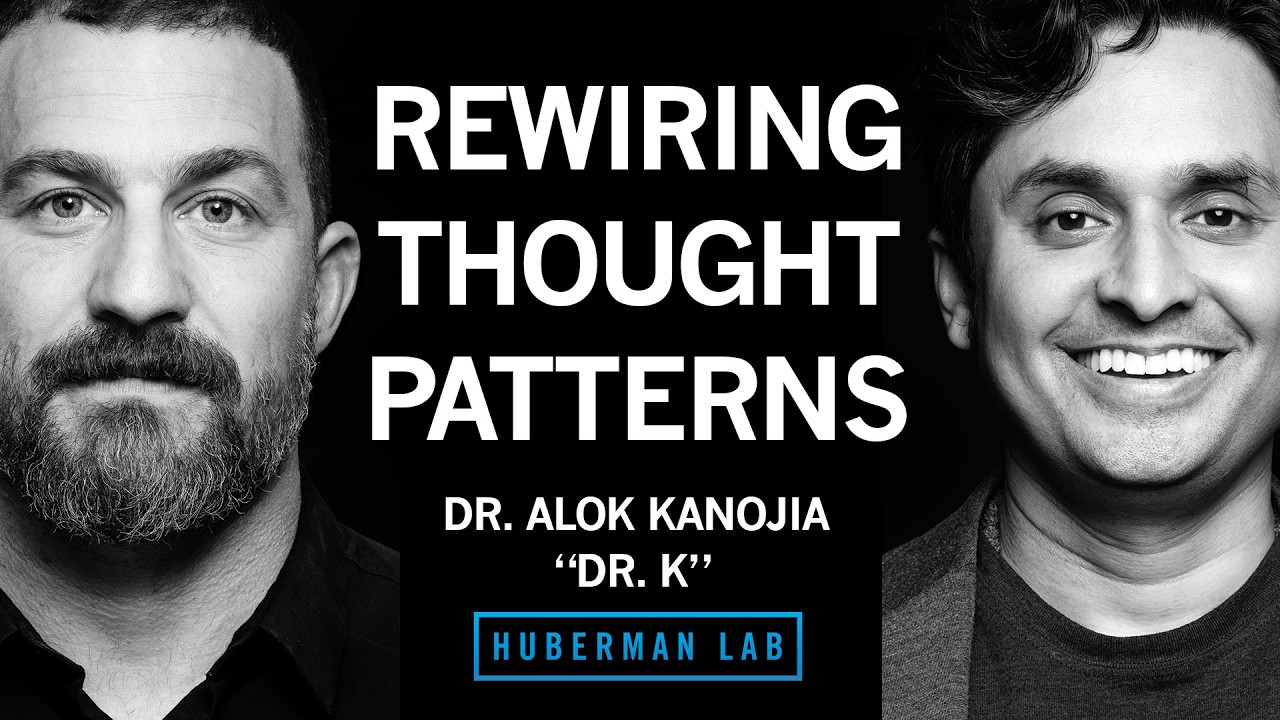
Unlearn Negative Thoughts & Behaviors Patterns | Dr. Alok Kanojia (Healthy Gamer)
Episode Summary
AI-generated · Mar 2026AI-generated summary — may contain inaccuracies. Not a substitute for the full episode or professional advice.
In this episode, Dr. Andrew Huberman welcomes Dr. Alok Kanojia, a psychiatrist and online mental health educator known as Dr. K, who uniquely blends his medical training with a seven-year background as a monk. Dr. K introduces a central thesis that true behavioral change doesn't rely on willpower to overcome tendencies, but rather on changing the underlying tendencies themselves, citing how psychotherapy can transform personality disorders and improve self-esteem to resolve conditions like depression and trauma.
The conversation delves into the unique challenges of the internet age, particularly how social media selects for emotional activation and arousal, fostering a dichotomy of emotions (scaring and delighting users) that is cognitively and emotionally draining. Dr. K argues that this environment contributes to increased narcissism and a decline in "distress tolerance" – the human capacity to sit with discomfort – leading to a surge in mental illnesses. He offers a practical, three-pronged framework for developing distress tolerance: first, putting words to emotions to calm the amygdala; second, cultivating additional emotions (both positive and negative) for emotional flexibility, and third, understanding emotions not as behaviors to be unleashed, but as crucial information and motivation, guiding one to ask: "What is this emotion telling me to do?"
Dr. K further explores the Eastern concept of the "ego," defining it as anything one identifies with after saying "I am..." (e.g., roles, achievements, comparisons). He posits that desires born from external conditioning, comparisons, or the ego's need for validation, while potentially leading to success, often fail to deliver lasting happiness because the ego is inherently insatiable and constantly moves goalposts. Instead, true fulfillment stems from an internal drive, a "heart's desire" that manifests as a consistent physical energy, independent of external metrics.
To access this deeper self and navigate the friction of external pressures versus internal truth, Dr. K introduces the concept of "shunya" (void/emptiness) – the self beyond the mind and ego. He describes shunya as a raw, narrative-free experience, accessible through specific meditation practices like focusing on the solar plexus or the stillness between breaths. This practice allows one to observe emotions and mental states from a detached perspective, fostering profound resilience against external criticisms and internal turmoil. The episode concludes by addressing "samscars," or emotional scars and maladaptations, explaining that trauma creates focused emotional states that engrain these patterns, and that practices like yoga nidra, with its "salpa" (reprogramming intention), aim to "burn them down to the roots" by cultivating a one-pointedness of mind to unlearn unhealthy subconscious programming.
Listeners will walk away with a profound understanding of the distinctions between external conditioning and authentic internal drive, practical tools for emotional regulation and resilience, and a fresh perspective on the ego and self. The episode provides a roadmap for cultivating inner peace and genuine happiness by consciously shaping one's internal landscape, rather than merely reacting to external circumstances or pursuing ego-driven achievements.
👤 Who Should Listen
- Anyone struggling with negative thought patterns or compulsive behaviors they wish to unlearn.
- Individuals feeling overwhelmed by external expectations versus their internal sense of self and purpose.
- People seeking practical tools for emotional regulation and developing greater resilience.
- Social media users and content creators looking to understand the psychological impacts of online interaction and criticism.
- Those interested in Eastern philosophies of mind and self-development, particularly concepts of ego and consciousness.
- Individuals exploring alternative approaches to mental health beyond traditional Western psychotherapy or willpower-based strategies.
🔑 Key Takeaways
- 1.True behavioral change involves altering underlying tendencies rather than solely relying on willpower to suppress unwanted behaviors, as demonstrated in psychotherapy [00:00].
- 2.The internet's design selects for intense emotional activation, leading to a constant state of arousal that is cognitively and emotionally draining, contributing to a rise in mental health issues [27:29].
- 3.Distress tolerance, the capacity to sit with discomfort, is a critical transdiagnostic factor for mental health, and its decline correlates with increased mental illness [12:11].
- 4.Developing distress tolerance involves three steps: putting words to emotions to calm the amygdala, cultivating additional emotions (positive and negative) for flexibility, and understanding emotions as information and motivation, not solely as authentic behaviors [31:31].
- 5.The "ego," in the Eastern sense, encompasses anything one defines themselves as ("I am..."), and pursuing desires born from comparison or external conditioning through the ego often leads to success without lasting happiness [47:54, 51:58].
- 6."Shunya," or void/emptiness, represents the self beyond the mind and ego, and accessing this state through specific meditation practices can foster profound internal peace and resilience [74:21, 77:25].
- 7."Samscars" are emotional energies or scars that linger from past experiences and maladaptations, shaping one's perception of the world, and can be 'burned down' through practices like yoga nidra's "salpa" by reprogramming the subconscious [90:37, 93:39].
- 8.One-pointedness of the mind, often heightened during intense emotional experiences (like trauma), is the mechanism by which deep learning and subconscious programming occur, which can be leveraged for therapeutic unlearning [95:42, 96:42].
💡 Key Concepts Explained
Distress Tolerance
This refers to the human capacity to endure or sit with uncomfortable thoughts, feelings, or situations without reacting impulsively or defensively. The episode highlights that distress tolerance is a critical transdiagnostic factor for mental health, and its decline in modern society correlates with an increase in various mental illnesses.
Ego (Eastern Perspective)
From an Eastern contemplative tradition, the ego is defined as anything one identifies with after saying "I am..." (e.g., roles, titles, achievements, comparisons). This framework views the ego as a necessary but often misleading part of functioning in the world, whose insatiable nature, driven by comparison and external validation, can lead to unhappiness even in success.
Shunya (Void/Emptiness)
Shunya is an Eastern concept representing a fundamental state of void, emptiness, or stillness that exists beyond thoughts, emotions, and the ego. Accessing shunya through specific meditative practices allows one to experience a raw, narrative-free self, fostering deep peace, resilience, and the ability to observe mental states without identifying with them.
Samscars
Samscars are emotional energies, impressions, or 'scars' that linger from past experiences, particularly traumas or significant emotional events. These subconscious patterns shape how an individual perceives the world and reacts to new situations, often leading to maladaptive behaviors. Yoga nidra's 'salpa' practice aims to 'burn down' these samscars by reprogramming the subconscious mind through focused intention.
⚡ Actionable Takeaways
- →When experiencing intense emotion, practice putting words to it to calm your amygdala and engage linguistic centers, aiding in processing and understanding [31:31].
- →Cultivate emotional flexibility by actively considering additional emotions, both positive (when feeling negative) and negative (when feeling overly positive, e.g., asking "What could go wrong?") [34:34, 35:36].
- →Reframe emotions as information and motivation; instead of letting emotions dictate behavior, ask "What is this emotion telling me?" to guide your actions [37:39].
- →To better understand your true desires, consciously step away from social media conditioning and avoid motivations born purely from comparison with others, recognizing the ego's insatiable nature [50:57, 51:58].
- →Practice "shunya" meditation by closing your eyes and focusing on the absence of feeling in your solar plexus or the stillness between your breaths to connect with the self beyond ego and mind [76:25, 77:25].
- →Observe your reaction to criticism: if it determines your value, it's personal and ego-driven; if you consider it empathically or dismiss it as projection, it helps step away from ego [61:04, 62:05].
- →Recognize that an authentic internal drive often presents as a consistent "physical energy" or feeling of being "pulled toward" something, rather than external goals or comparisons; pay attention to these internal signals [49:57, 50:57].
⏱ Timeline Breakdown
💬 Notable Quotes
“"Willpower is necessary when you are trying to not be narcissistic. It is not necessary when you are no longer narcissistic." [00:00]”
“"My job is not to make people feel safe. My job is to make people safe. And there's actually a big difference." [10:09]”
“"The biggest mistake that I see pe uh people make, especially high performers, is a problem of misdiagnosis." [19:21]”
“"The ego is never going to be satisfied. The ego by its nature is comparative. And even if you're number one, people think this the most anxious people I've ever worked with, not actually true, but yeah. Is people who get to the top and you think that you're done. You're not done." [58:01]”
More from this guest
Dr. Alok Kanojia
📚 Books Mentioned
Listen to Full Episode
📬 Get weekly summaries like this one
No spam. Unsubscribe anytime. By subscribing you agree to our Privacy Policy.
Continue Exploring